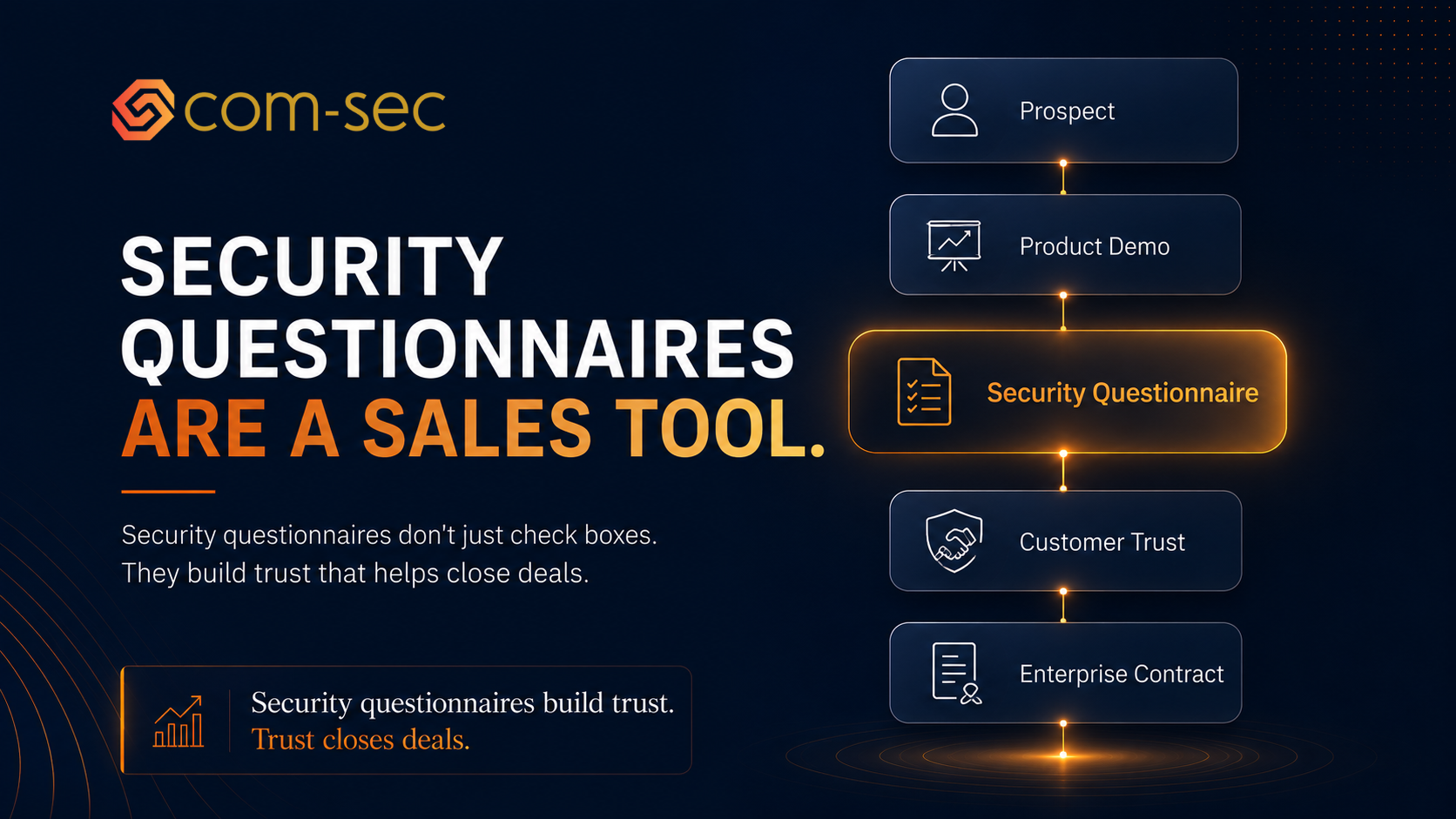
Most companies treat security questionnaires as a nuisance. Something the sales team forwards to whoever knows the most about security, with a note that says "customer needs this by Friday."
That's a missed opportunity. A well-answered security questionnaire doesn't just check a box. It builds trust with the customer, differentiates you from competitors who give vague answers, and shortens the sales cycle by removing security as a blocker.
What bad answers look like
"Yes." No context, no explanation, no evidence.
"We follow industry best practices." This means nothing. Every company says this.
"Please refer to our SOC 2 report." The customer asked a specific question. They want a specific answer, not a homework assignment.
"N/A." Used too broadly. If a question doesn't apply, explain why in one sentence.
What good answers look like
"Yes. We enforce MFA across all corporate applications through Okta. SSO is required for all production systems. MFA enrollment is verified during onboarding and audited quarterly."
That answer takes 30 seconds to write and tells the customer exactly what they need to know. It's specific, defensible, and shows you actually do what you claim.
The rules I follow
Be accurate. Don't say "yes" unless the control is truly implemented. "Yes, with explanation" or "Partially implemented" are better than a false yes that unravels during due diligence.
Be specific. Name the tools, describe the process, mention the frequency. Generic answers signal that you either don't know or don't want to say.
Don't overstate. Avoid "fully compliant," "guaranteed secure," or "zero risk." These phrases are red flags for experienced security reviewers.
Be concise. Nobody wants to read a paragraph when a sentence will do. But a one-word answer isn't concise, it's lazy.
Flag what's planned. "Not currently implemented. Planned for Q3 as part of our SOC 2 readiness program." That's an honest answer that shows maturity and a roadmap.
The strategic angle
If your company responds to a lot of questionnaires, build a response library. Standardize your answers around your actual controls, map them to your SOC 2 or ISO 27001 evidence, and update the library after each audit cycle. This turns a 3-day exercise into a 3-hour exercise and improves consistency.
The bottom line
The companies that treat questionnaires as a sales asset close deals faster than the ones that treat them as a compliance burden.