If you're selling to enterprise customers in the United States, SOC 2 compliance is no longer optional. It's expected.
But here's the problem: most teams don't struggle with what SOC 2 is. They struggle with how to actually prepare for it without wasting months, missing controls, or failing the audit.
The good news? SOC 2 preparation isn't random or overly complex. It follows a clear, structured path. Once you understand that path, the process becomes far more manageable.
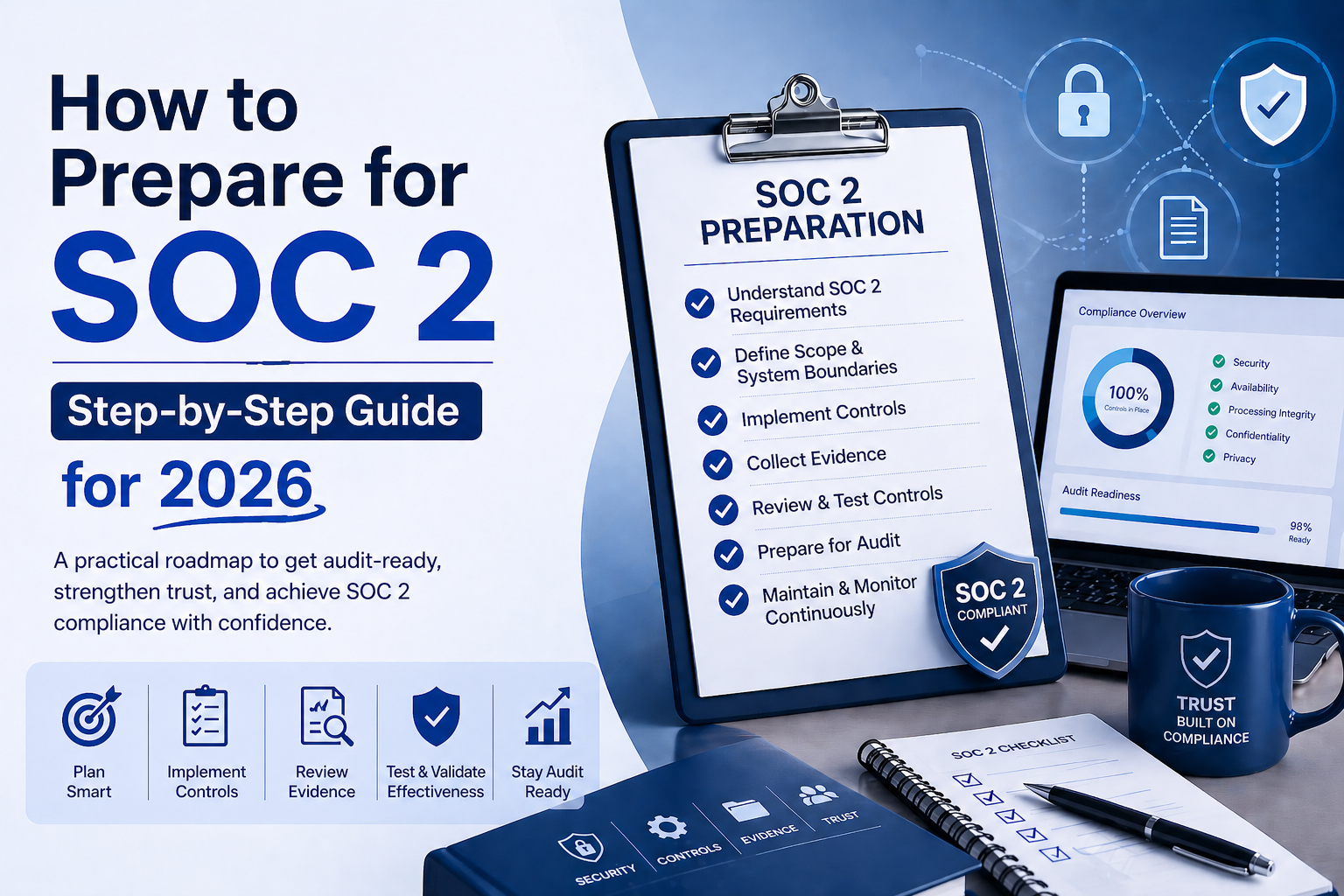
This guide walks you through exactly how to prepare for SOC 2, from your first readiness assessment to passing the audit with confidence.
What is SOC 2?
SOC 2 is a compliance framework developed by the American Institute of Certified Public Accountants (AICPA). It evaluates how your company handles customer data using five key principles: security, availability, processing integrity, confidentiality, and privacy.
For most SaaS and technology companies, SOC 2 plays a direct role in revenue growth. Enterprise buyers often require it before signing contracts, and without it, deals can stall or fall through entirely.
You'll also come across two types of SOC 2 reports. Type I evaluates your controls at a single point in time, while Type II assesses how those controls perform over a longer period, usually several months. In practice, most companies aim for Type II because it demonstrates ongoing reliability.
The key takeaway is simple: SOC 2 isn't just about compliance. It's about building trust and unlocking larger business opportunities.
Step-by-Step SOC 2 Preparation
Preparing for SOC 2 is best approached as a sequence of steps. Each stage builds on the previous one, and skipping ahead usually creates more work later.
Readiness Assessment
Every successful SOC 2 journey starts with a readiness assessment, often referred to as a SOC 2 Assessment. This is where you take an honest look at your current systems, policies, and processes to identify what's missing.
Think of it as a gap analysis. You compare what you have today against what SOC 2 requires, and the differences become your action plan.
During this phase, teams typically define the audit scope, review existing controls, perform a detailed risk assessment, and improve overall SOC 2 readiness. The outcome is a clear roadmap of what needs to be fixed before you involve an auditor.
Skipping this step is one of the most common and costly mistakes. Without it, companies often enter audits unprepared and end up repeating work under time pressure.
Policy Creation
Once you understand your gaps, the next step is building the right policies.
Policies are more than documents. They're the foundation of your compliance program. They define how your organization handles security, access, incidents, and data protection.
At a minimum, you'll need policies for access control, incident response, change management, and data security. But simply writing these policies isn't enough. They must reflect how your organization actually operates.
Auditors are quick to spot generic or unused policies. What they're really looking for is alignment — documentation that matches real-world practices. These policies form the backbone of your internal controls and support your overall compliance framework.
Control Implementation
With policies in place, the focus shifts to implementing controls.
Controls are the mechanisms that enforce your policies. They include both technical safeguards such as multi-factor authentication and system monitoring, and operational processes such as employee onboarding and access reviews.
This is where SOC 2 becomes real. It's not about what you say you do. It's about what your systems and teams consistently execute.
Strong controls share three characteristics: they are clearly defined, properly implemented, and consistently followed. If any one of those is missing, the control may fail during the audit. Auditors will evaluate whether your data security controls are effective and consistently enforced to demonstrate strong control effectiveness.
Evidence Gathering
Once your controls are running, you need to prove it — and that's where evidence comes in.
SOC 2 auditors rely heavily on evidence to verify that your controls are functioning over time. This can include system logs, screenshots, access records, training logs, and configuration reports.
Many teams underestimate this step. They wait until the audit begins and then scramble to collect documentation, which often leads to delays.
A better approach is to treat evidence collection as an ongoing process. The earlier you start, the smoother your audit will be. A well-defined evidence collection process, supported by continuous monitoring, helps ensure you remain audit-ready at all times.
Audit Process
After implementing controls and gathering evidence, you're ready for the audit itself.
The process typically begins with selecting a SOC 2 Type I or Type II audit and following a structured SOC 2 audit checklist during the defined audit period. From there, the auditor examines your documentation, tests your controls, and evaluates whether they meet SOC 2 requirements. At the end of the audit, the auditor issues your official SOC 2 report, which can be shared with customers and stakeholders.
This stage is structured, but it can still be demanding, especially if gaps are discovered late.
Who Can Perform a SOC 2 Audit?
This is an important point that often causes confusion.
SOC 2 audits can only be performed by a licensed CPA firm. Internal teams, consultants, or compliance platforms can help you prepare, but they cannot issue the official SOC 2 report.
Not all CPA firms are the same, though. Experience with SOC 2 audits, familiarity with SaaS environments, and clear communication can make a significant difference in your audit experience.
If you're unsure how to evaluate auditors, it's worth taking a deeper look at your options before signing an agreement.
Common Challenges in SOC 2 Preparation
Even with a clear process, many organizations run into similar challenges.
One of the biggest issues is treating SOC 2 like a checklist rather than a system. When teams focus only on ticking boxes, they often miss the bigger picture, which is consistent execution.
Another common problem is poor documentation. Controls may exist, but without proper evidence, they're difficult to verify.
Timing also plays a role. Starting too late, especially during active sales cycles, can create unnecessary pressure and rushed implementations.
Understanding these challenges early can help you avoid them altogether.
Tools & Platforms
Today, many companies use compliance platforms to simplify SOC 2 preparation.
SOC 2 automation tools and SOC 2 compliance services can automate evidence collection, monitor controls continuously, and reduce manual effort across teams. For organizations with limited resources, they can significantly speed up the process.
That said, it's important to understand their role. Compliance platforms support your preparation but they don't replace the audit itself. You'll still need a licensed CPA firm to complete the process.
Conclusion
Preparing for SOC 2 might seem complex at first, but it becomes much clearer when broken into steps.
The process begins with assessing your current state, then moves into building policies, implementing controls, and gathering the necessary evidence. With the guidance of Com-Sec, organizations can navigate these stages more efficiently and with greater confidence. By the time you reach the audit stage, it's largely a validation of the systems and practices you've already put in place.
When approached correctly, SOC 2 compliance isn't just about passing an audit. It's about building a stronger, more trustworthy organization.