I've helped dozens of companies get through SOC 2. The single biggest obstacle isn't the audit, the evidence collection, or the controls. It's the confusion about what SOC 2 actually is.
So let me make this as simple as possible.
What SOC 2 actually is
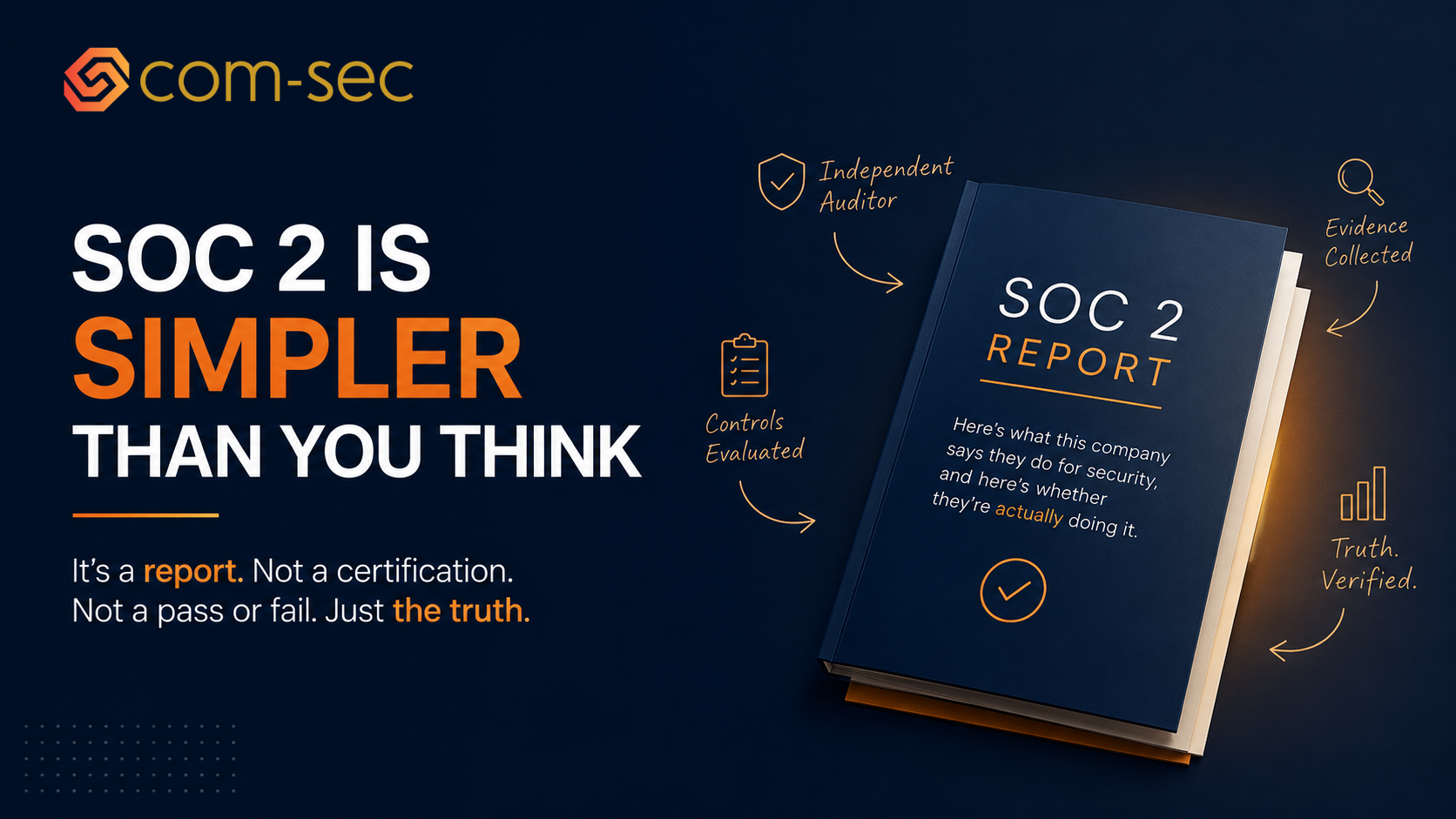
SOC 2 is a report. That's it. It's not a certification. It's not a pass/fail test. It's not a checklist of requirements you have to meet.
It's a report that says: here's what this company says they do for security, and here's whether they're actually doing it.
An independent auditor looks at your controls, your policies, and your processes. They collect evidence. They test whether those controls are working the way you described. Then they write a report that other people (your customers, their security teams, their procurement departments) can read to understand your security posture.
That's the whole thing.
You can't fail a SOC 2
This is the part that trips people up the most. There is no pass or fail. There's no score. There's no minimum threshold you have to clear.
The auditor's job is to evaluate whether the controls you defined are suitably designed and operating effectively. If you say you do quarterly access reviews and you actually do quarterly access reviews, that control passes. If you say you do quarterly access reviews and you haven't done one in eight months, the auditor notes that as an exception.
Exceptions show up in the report. They don't kill it. A SOC 2 report with a few documented exceptions and clear remediation steps is a normal, honest report. It tells the reader: this company has a real program, they found some gaps, and they're fixing them.
A report with zero exceptions can actually raise more eyebrows with experienced security reviewers. It either means the company's program is genuinely mature, or it means the audit wasn't very thorough.
Why this matters
The confusion around SOC 2 creates two problems.
First, it makes founders overthink it. They treat SOC 2 like a bar exam and delay starting because they think they're not "ready." You don't need to be perfect. You need to have controls that are defined, documented, and operating. If there are gaps, the audit process helps you find and fix them.
Second, it lets companies hide behind it. "We're SOC 2 compliant" has become a shorthand that implies more than it should. SOC 2 doesn't mean a company is secure. It means an auditor reviewed the controls the company chose to include and confirmed they were working during a specific period. The controls the company didn't include, the risks they didn't scope, and the things that happened outside the audit window are all outside the report.
Type I vs. Type II
Type I is a point-in-time snapshot. The auditor looks at your controls on a single date and says: as of this date, these controls are suitably designed. It's a good starting point, especially for companies getting their first report.
Type II covers a review period, usually 6 to 12 months. The auditor evaluates whether your controls were operating effectively throughout that window. This is what most enterprise customers want to see because it shows consistency, not just a one-day setup.
What SOC 2 covers
SOC 2 is built around Trust Services Criteria. The required category is Security. You can optionally add Availability, Confidentiality, Processing Integrity, and Privacy depending on what matters for your business and what your customers ask for.
Within those categories, you define your own controls. There's no fixed list of 200 requirements you have to meet. You decide what controls are appropriate for your environment, your risk profile, and your customer commitments. The auditor evaluates whether those controls are designed well and working.
This is why two SOC 2 reports from two different companies can look completely different and both be valid. The framework is flexible by design.
The simplest way to think about it
Imagine you're telling a customer: "Here's how we handle security. Here's how we manage access. Here's how we protect your data. Here's what happens if something goes wrong." SOC 2 is an independent auditor verifying that what you just told them is true. That's all it is. Don't overcomplicate it.