The most common question I get from health tech founders about AI: "Can we use Claude and still be HIPAA compliant?"
The answer is: it depends entirely on how you use it and which product surface you're on. And the details matter more than most companies realize.
The BAA landscape
Anthropic offers a Business Associate Agreement for its HIPAA-eligible services. But not everything with the Claude name on it is covered.
✅ What's covered under the BAA (as of May 2026):
- The Claude Messages API
- Claude Enterprise (with HIPAA mode enabled by an admin)
- Claude Code CLI (only with ZDR enabled on a qualified account)
❌ What's NOT covered:
- Claude Free, Pro, Max, or Team plans
- Cowork
- Claude in Chrome
- Claude in Excel
- Features currently in beta
- Web search functionality
- Batch API, Files API, and several other API features
If your company signed a BAA and assumed it covered everything your team uses, go check. The coverage gaps are significant, and Anthropic updates them regularly.
Zero data retention
ZDR is a separate arrangement where Anthropic does not store your inputs or outputs after the API response is returned, except where needed for legal compliance or abuse prevention. This is available for qualified Enterprise API and Claude Code customers.
Key points companies miss about ZDR:
It's not automatic. You have to request it through Anthropic's sales team, and they review eligibility.
It's enabled per-organization. If you create a new organization under the same account, ZDR doesn't carry over. You need to enable it separately.
It doesn't cover everything. Even with ZDR enabled, certain features are automatically disabled: Batch API, Files API, Skills API, code execution, programmatic tool calling, and MCP connectors.
Anthropic still retains User Safety classifier results under ZDR to enforce their usage policy.
For healthcare companies, this means your architecture decisions matter. If you need HIPAA coverage, you're either going through Anthropic's Enterprise path with the BAA and appropriate configurations, or you're running Claude through AWS Bedrock or Google Vertex AI under those platforms' compliance frameworks. Each path has tradeoffs.
The third-party platform option
Running Claude through AWS Bedrock is often the cleanest compliance path for regulated companies. Bedrock was added to AWS's HIPAA Eligible Services in February 2026. Under this model, Anthropic doesn't see your prompts or completions. The data stays in your AWS VPC, under your AWS BAA. You don't need a separate Anthropic BAA.
The same applies to Google Vertex AI and Microsoft Azure AI Foundry. If your company already has a cloud provider BAA and compliance framework in place, running Claude through that provider may be simpler than navigating Anthropic's direct compliance path.
The practical takeaway
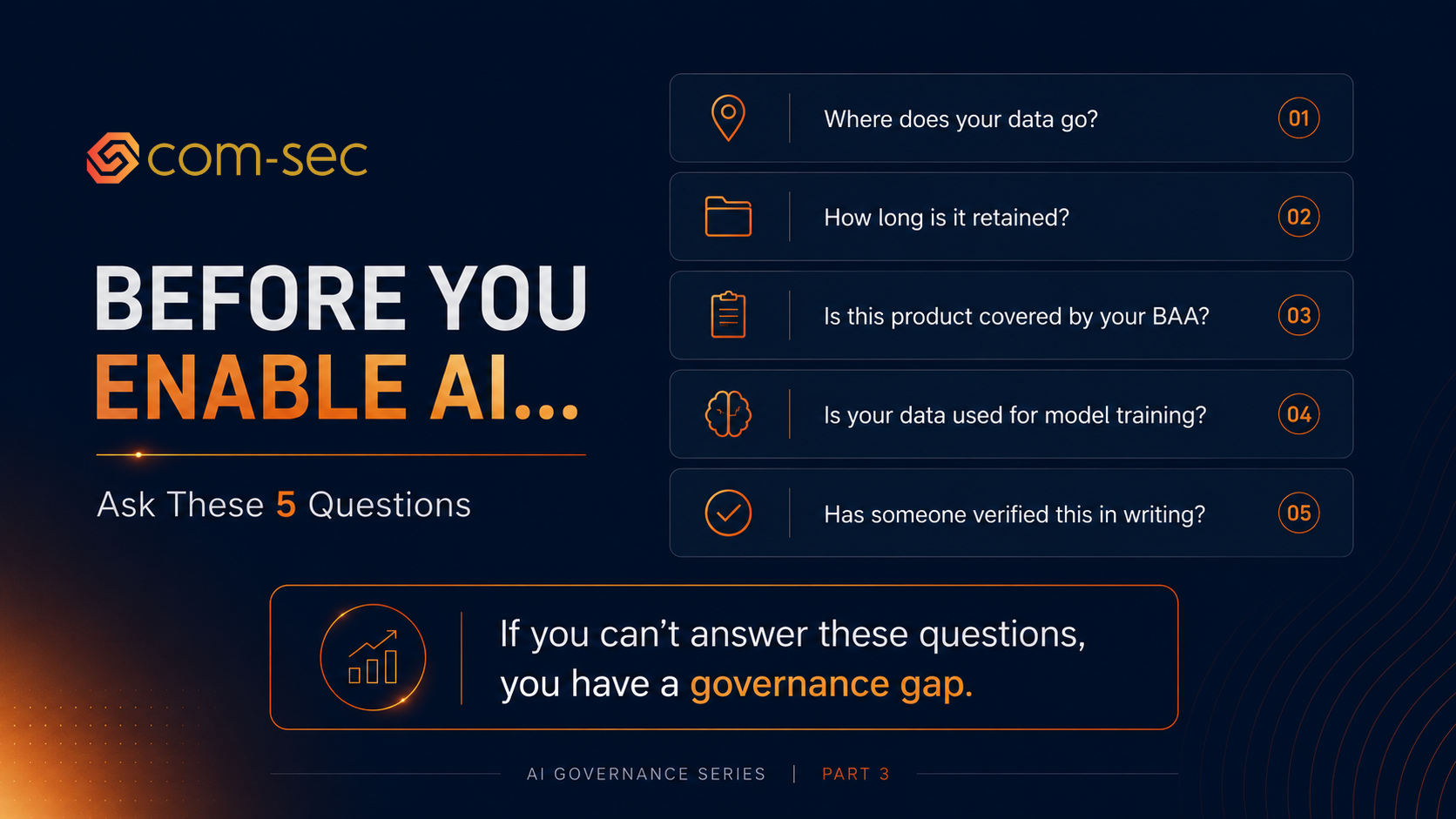
Before you enable any AI tool at your company, answer these questions:
- Where does data go when it enters this tool?
- How long is it retained?
- Is this product surface covered under your BAA?
- Is data used for model training?
- Who at your company has verified this in writing, not just read a marketing page?
If you can't answer those questions for every AI tool your team uses, you have a governance gap.
Up next in the series
In Part 4, we build the actual rollout playbook — a practical 5-step program for rolling out AI at a company that takes security and compliance seriously.
Read Part 4 →