You've understood the governance need, the risks of agentic tools, and the data handling landscape. Now let's build the actual program. This is a practical playbook for rolling out AI at a company that takes security and compliance seriously.
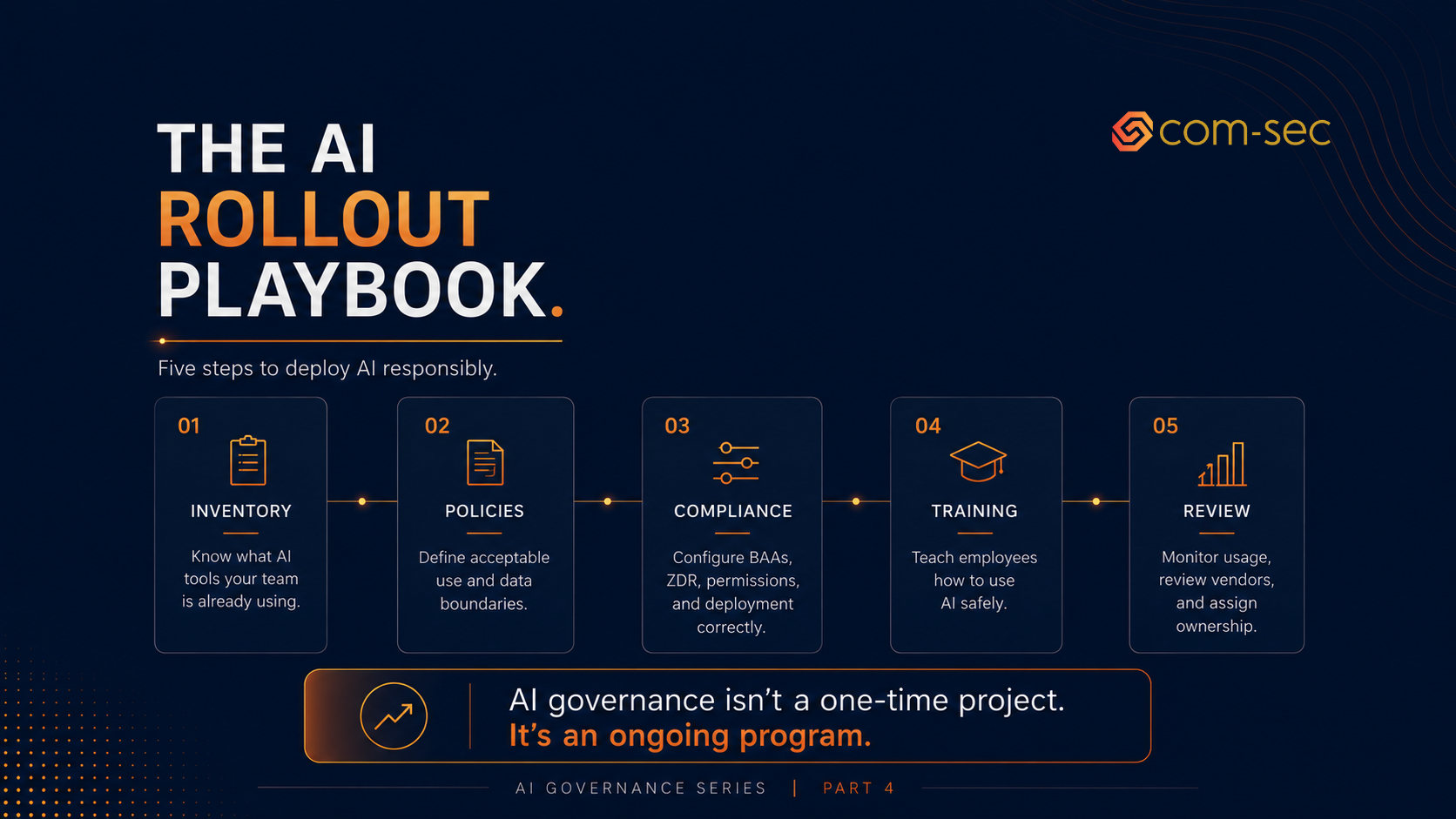
Step 1: Inventory what's already in use
Before you write a single policy, find out what your team is already using. In most companies, AI adoption has been bottom-up. Individual employees have signed up for tools, connected APIs, and started building without formal approval. You can't govern what you don't know about.
Survey your team. Check expense reports for AI subscriptions. Review browser extensions and installed applications. Look at API keys in your environment. Check SSO/SAML logs for shadow SaaS.
Build a simple inventory: tool name, who's using it, what data goes into it, what plan/tier, and whether it's covered under any compliance framework.
Step 2: Define acceptable use
Write an AI acceptable use policy. Keep it short and enforceable. Cover:
Approved tools and tiers. Specify which AI tools are sanctioned and at what plan level. "Claude Enterprise with HIPAA mode" is very different from "Claude Pro on a personal account."
Data classification. Define what data can and cannot be entered into AI tools. Customer data, PHI, PII, source code, credentials, internal financials: draw clear lines.
Human oversight requirements. Any AI-generated output that affects a customer, goes into a product, or is used for a business decision needs human review before it's final.
Agentic tool restrictions. For tools like Cowork and Claude Code, define who can use them, on what machines, and in what mode. "Ask before acting" should be the default for any employee with privileged access.
Step 3: Configure for compliance
If you're in a regulated industry, get the technical configuration right before you roll out:
Sign the right agreements. BAA, DPA, ZDR: whatever your regulatory requirements demand, get the paperwork done before your team starts using the tools.
Enable the right controls. If you're on Claude Enterprise, enable HIPAA mode in admin settings before anyone processes PHI. If you're using the API, confirm ZDR is active on your organization.
Block what shouldn't be used. If certain features aren't covered under your BAA (web search, Cowork, beta features), disable them at the admin level or add them to your blocklist.
Choose your deployment path. Direct Anthropic API with ZDR, or through a cloud provider (Bedrock, Vertex, Azure) under the cloud's compliance framework. Make a deliberate decision, don't let it happen by default.
Step 4: Train your team
Most AI risk comes from well-intentioned employees who don't understand the boundaries. A 30-minute training session covering acceptable use, data handling rules, and the specific risks of agentic tools will prevent the majority of incidents.
Key points to cover: what data never goes into AI tools, how to use Cowork safely (if approved), the difference between consumer and enterprise AI products, and what to do if they're unsure whether a use case is approved.
Step 5: Monitor and review
AI governance isn't a one-time setup. Review quarterly:
- Is the tool inventory still accurate?
- Are there new AI tools in use that haven't been evaluated?
- Are acceptable use policies being followed?
- Have any incidents or near-misses occurred?
- Have the vendors updated their data handling, BAA coverage, or feature eligibility?
Assign ownership. Someone at your company needs to own AI governance. This can be your vCISO, your security lead, or your compliance manager. It doesn't need to be a full-time job, but it needs to be someone's responsibility.
Up next in the series
In Part 5, we'll bring it all together with a maturity model and the common mistakes to avoid.
Read Part 5 →