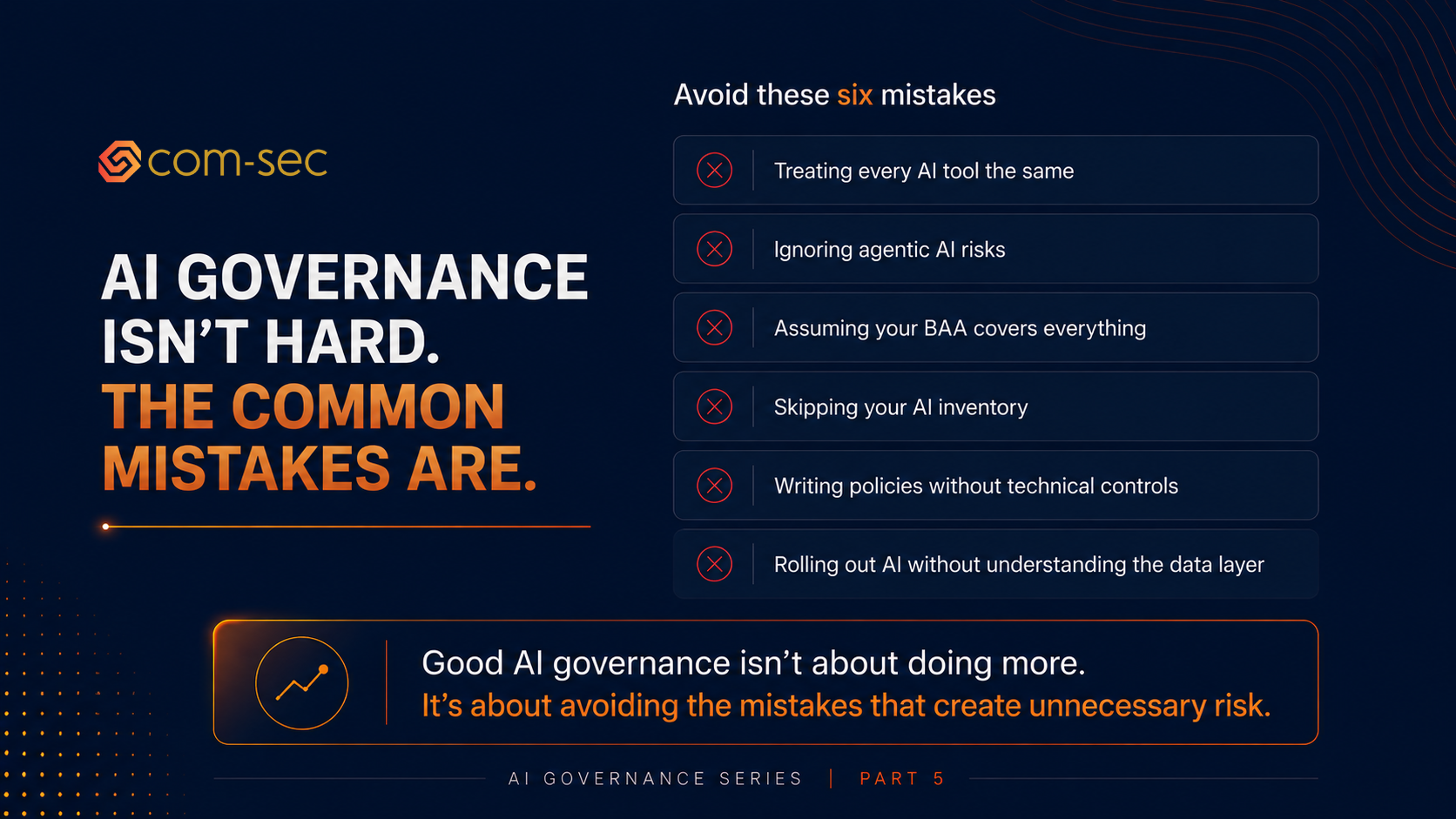
After walking through governance fundamentals, agentic tool risks, data handling intricacies, and the rollout playbook, let's close with the mistakes I see most often and how to avoid them.
Mistake 1: Treating all AI tools the same
Claude Free and Claude Enterprise are fundamentally different products from a compliance perspective. A developer using Claude Code through the API with ZDR enabled has a completely different risk profile than a marketing manager using Claude Pro on a personal account. Your governance model needs to account for these differences.
One policy that says "employees may use AI" without distinguishing between tool, tier, and use case is a policy that doesn't protect you.
Mistake 2: Ignoring agentic risk
Cowork, Claude Code, and similar agentic tools are qualitatively different from chatbots. They can take actions, modify files, execute commands, and interact with systems. An engineer with admin access to your cloud environment running Cowork in "act without asking" mode is one bad prompt away from a production incident.
This isn't theoretical. Companies need to treat agentic AI the way they treat privileged access: with defined boundaries, monitoring, and the principle of least privilege.
Mistake 3: Assuming the BAA covers everything
I've seen health tech companies sign Anthropic's BAA and then let their team use Claude Pro, Cowork, and web search features, none of which are covered. The BAA is specific about what's in scope. Read the implementation guide. Check the feature eligibility table. Don't assume.
Mistake 4: Skipping the inventory
If you don't know what AI tools are in your environment, your governance program is performative. Shadow AI is real and growing. Every quarter, new tools show up. The inventory step isn't optional.
Mistake 5: Writing policy without configuring controls
A policy that says "employees shall not enter PHI into AI tools" is meaningless if you haven't disabled the features that make it easy to do so. Policy without technical controls is a suggestion. Configure admin settings, blocklists, and access controls to enforce what your policy says.
Mistake 6: Moving fast without understanding the data layer
The AI industry is moving at breakneck speed. New features launch weekly. Data handling policies change. BAA coverage evolves. ZDR eligibility shifts. What was true six months ago may not be true today.
Companies that roll out AI tools without understanding where data goes, how long it's retained, and whether it's used for training are creating exposure they may not discover until an audit or incident forces the question.
The path forward
AI governance doesn't have to be heavy. For most companies, it's an inventory, a policy, the right technical configuration, a training session, and a quarterly review. That's a few days of work, not a six-month project.
The companies that build this discipline now will be in a much stronger position with customers, auditors, and regulators. The ones that wait will eventually have to do it anyway, probably under less favorable circumstances.
If you're figuring out where to start, that's exactly the kind of problem we help solve.
Series complete
That wraps up the 5-part playbook. Catch up on any part you missed below, or reach out if you're ready to put this into practice.