In 2026, the question for US healthcare systems is no longer if they should use AI, but how to govern the autonomous agents now navigating their EHRs, payer rules, and clinical workflows. Unlike traditional "static" AI, Agentic AI functions as a digital workforce. Without a robust governance framework and lifecycle management (ALM), these agents risk becoming "shadow AI" liabilities.
Why Agentic AI Governance is Non-Negotiable in 2026
Traditional AI governance focused on model accuracy. Today, the focus has shifted to decision impact. When an AI agent autonomously resubmits a denied claim or flags a patient for sepsis intervention, the "blast radius" of an error is significantly larger.
Recent data from HIMSS26 suggests that while 80% of healthcare leaders are deploying agents, only 22% feel confident in their ability to provide a full audit trail to regulators.
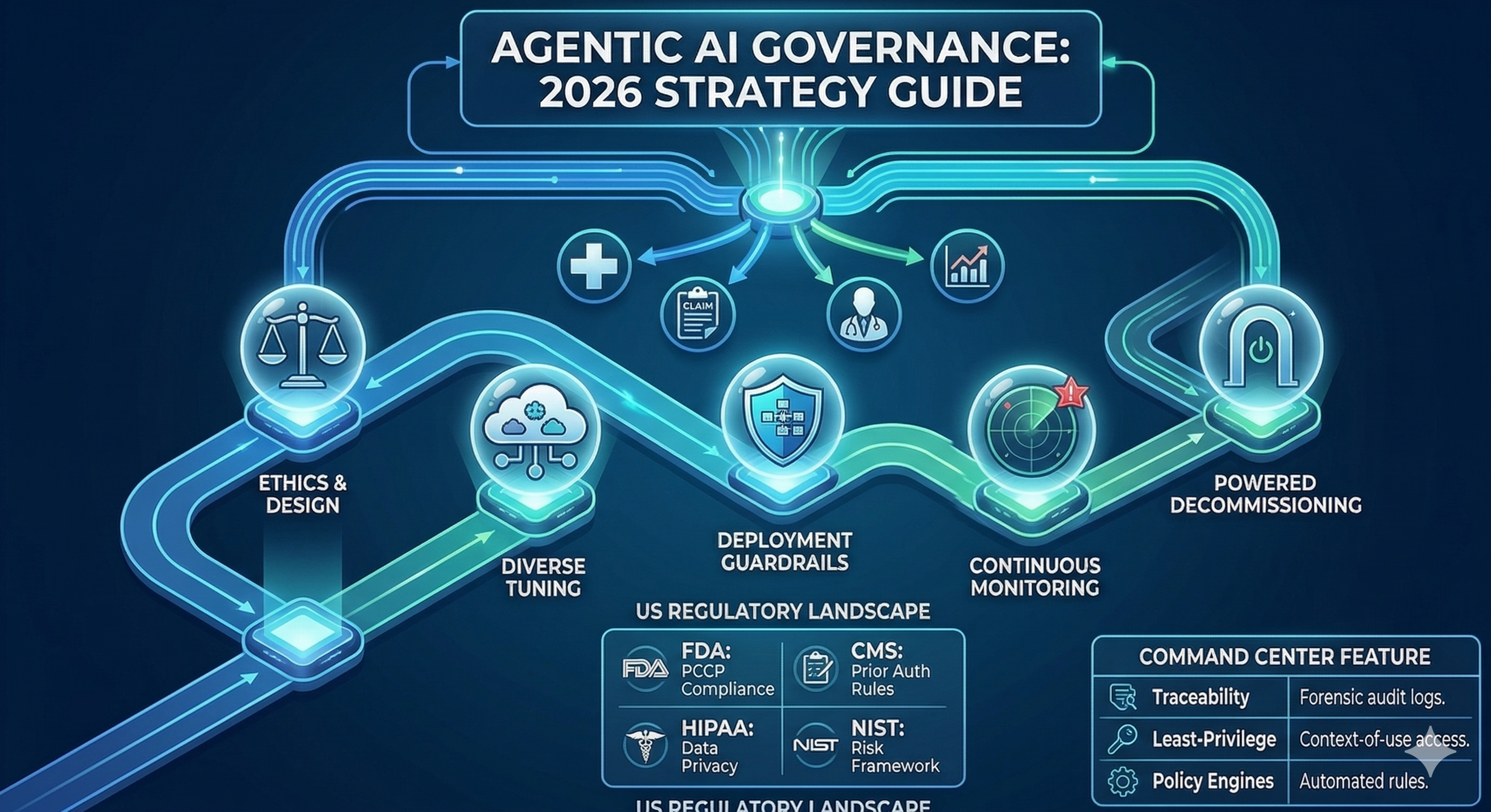
1. The Agentic AI Lifecycle: From Ideation to "Kill Switch"
Effective lifecycle management in healthcare requires a Total Product Life Cycle (TPLC) approach, as mirrored by the latest FDA guidances.
Phase 1: Perception & Design — Defining the "Context of Use." Is the agent assisting in Revenue Cycle Management (RCM) or clinical decision support?
Phase 2: Automated MLOps & Tuning — Testing the agent against diverse US patient demographics to mitigate algorithmic bias.
Phase 3: Deployment & Guardrails — Implementing "Governance-as-Code." Instead of manual reviews, guardrails are hardwired into the agent's DNA to prevent it from accessing unauthorized sensitive data.
Phase 4: Continuous Monitoring (AgentOps) — Real-time tracking of "Data Drift." In healthcare, a shift in clinical coding standards or a new payer policy can cause an agent's performance to "hallucinate" or degrade.
Phase 5: Retirement/Decommissioning — Knowing when to pull an agent offline when its underlying model (e.g., GPT-5 or Claude 4) becomes obsolete or noncompliant.
2. Navigating the US Regulatory Landscape
Governance must align with the "big three" regulatory pillars currently shaping the US market:
FDA's Jan 2026 Update: The FDA now emphasizes Pre-determined Change Control Plans (PCCP). This allows you to retrain and update your agents without a new 510(k) submission, provided the modifications stay within authorized boundaries.
CMS Prior Authorization Rule: AI agents are now at the center of Payer-Provider collaboration. Governance ensures these agents provide "machine-readable" and auditable decisions to meet CMS transparency mandates.
The "Human-in-the-Loop" Threshold: Governance defines exactly when an agent can act (e.g., scheduling an appointment) versus when it must escalate to a clinician (e.g., changing a medication dosage).
3. Best Practices for Implementing a "Command Center"
To avoid "Agent Sprawl," US health systems are adopting Centralized AI Orchestration.
| Feature | Description |
|---|---|
| Traceability | Every decision made by an agent must be logged for forensic analysis. |
| Least-Privilege Access | Agents should only "see" the data necessary for their specific task. |
| Policy Engines | Automated rules that stop an agent if it attempts to violate HIPAA or internal ethics. |
4. Real-World Use Cases of Agentic AI in U.S. Healthcare
Agentic AI is already delivering measurable impact across U.S. healthcare systems by acting as autonomous decision-making agents rather than passive tools. These systems are improving clinical outcomes, reducing administrative burden, and optimizing operational efficiency.
Clinical Decision Support (CDS)
One of the most impactful applications of AI in healthcare in the USA is in clinical decision support.
Agentic AI systems continuously monitor patient data—from vitals to lab results—and identify early warning signs of critical conditions such as sepsis, stroke, or cardiac events. Instead of waiting for symptoms to escalate, clinicians receive real-time, evidence-based alerts that enable faster intervention.
This shift from reactive care to predictive, proactive treatment not only improves patient outcomes but also reduces hospital mortality rates and ICU admissions.
Revenue Cycle Automation (RCM)
Healthcare providers in the U.S. lose billions annually due to denied claims and inefficient billing processes. Agentic AI is transforming revenue cycle management (RCM) by automating complex payer interactions.
AI agents can:
- Submit and resubmit insurance claims autonomously
- Predict claim denials before they occur
- Optimize medical coding for higher approval rates
The result is a faster, more efficient financial workflow with reduced administrative overhead and improved cash flow.
Medical Documentation Automation
Administrative burden is one of the leading causes of physician burnout in the U.S. healthcare system. Agentic AI addresses this challenge through AI-powered medical documentation.
These systems act as "ambient AI scribes," capturing patient-doctor conversations and automatically generating structured clinical notes within EHR systems.
By eliminating hours of manual documentation, healthcare providers can:
- Spend more time with patients
- Improve documentation accuracy
- Enhance overall care quality
Predictive Analytics & Risk Stratification
Agentic AI enables healthcare organizations to move beyond treatment and into prevention and population health management.
By analyzing large-scale patient data, AI agents can:
- Identify high-risk patients
- Predict hospital readmissions
- Detect chronic disease progression early
This allows providers to intervene earlier, reduce costs, and deliver personalized, data-driven care at scale.
Operational Efficiency & Workflow Automation
Behind the scenes, hospitals are complex systems with constant coordination challenges. Agentic AI improves hospital operations and workflow automation by optimizing:
- Staff scheduling
- Patient flow management
- Resource allocation (beds, equipment, ICU capacity)
These improvements lead to shorter wait times, better resource utilization, and a more seamless patient experience.
Key Challenges in Agentic AI Governance
While the benefits are significant, implementing AI governance in healthcare comes with serious challenges—especially in a highly regulated environment like the United States.
Regulatory Complexity: Healthcare organizations must continuously adapt to evolving FDA, CMS, and HIPAA requirements.
Legacy System Integration: Outdated infrastructure and limited interoperability hinder seamless AI adoption.
Trust and Explainability: Clinicians require transparent, interpretable AI outputs to confidently rely on automated systems.
Security Risks: Expanded system interactions increase exposure to data breaches and unauthorized access.
Scalability and Control: Managing multiple AI agents without centralized oversight can lead to operational inefficiencies.
Best Practices for Healthcare Organizations in 2026
To successfully implement Agentic AI, healthcare organizations must move beyond experimentation and adopt a structured, governance-first strategy.
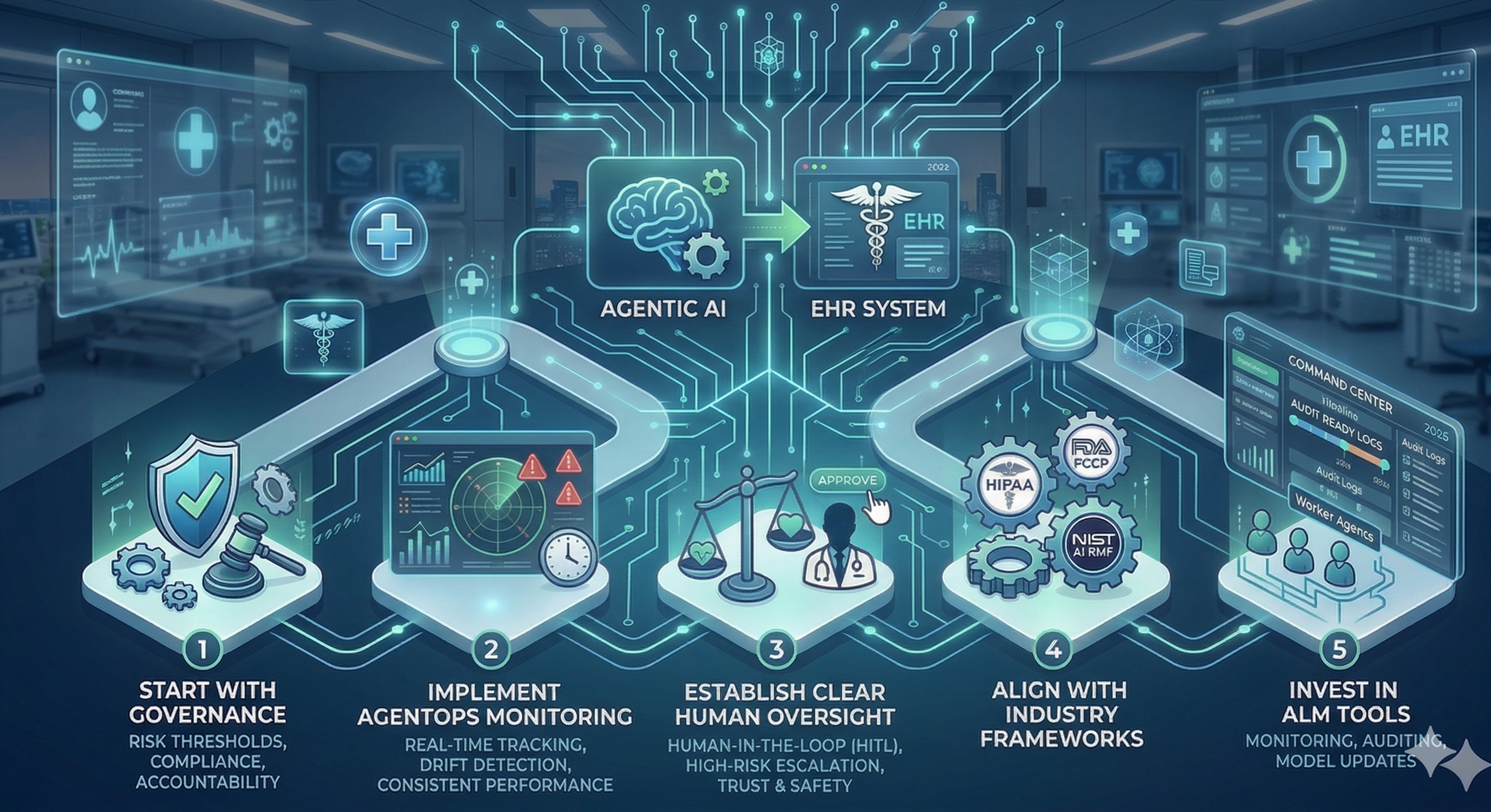
Start with Governance, Not Deployment. The most common mistake organizations make is focusing on AI capabilities before establishing governance. Instead, define compliance requirements, risk thresholds, and accountability structures. This ensures AI systems are safe, compliant, and scalable from the start.
Implement Continuous Monitoring (AgentOps). AI systems are not "set and forget." They require ongoing monitoring to ensure performance and compliance. With AgentOps, organizations can track AI decisions in real time, detect anomalies and data drift, and maintain consistent system performance.
Establish Clear Human Oversight. Not every decision should be automated. Healthcare organizations must define human-in-the-loop boundaries, ensuring that high-risk decisions require clinician approval and AI systems escalate when necessary. This balance is essential for maintaining patient safety and trust.
Align with Industry Frameworks. To reduce risk and ensure compliance, organizations should align with established standards such as HIPAA (data privacy and security), FDA PCCP (AI model updates), and the NIST AI Risk Management Framework. These frameworks provide a structured foundation for responsible AI adoption.
Invest in AI Lifecycle Management Tools. Managing AI at scale requires robust tools for monitoring, auditing, and updating models. AI lifecycle management platforms enable organizations to automate governance and maintain long-term system reliability.
Conclusion
Agentic AI in healthcare demands a governance-first approach to ensure compliance, security, and scalability across U.S. healthcare systems. By strengthening compliance and audit readiness and implementing AI governance and lifecycle management (ALM), organizations can effectively reduce risks while improving operational efficiency.
Adopting HIPAA-compliant AI solutions and healthcare cybersecurity services is critical to safeguard sensitive patient data and maintain regulatory alignment. With the support of robust risk management and secure AI infrastructure, healthcare providers can confidently scale autonomous AI systems. Partnering with Com-Sec Services enables healthcare organizations to build secure, compliant, and future-ready AI ecosystems.