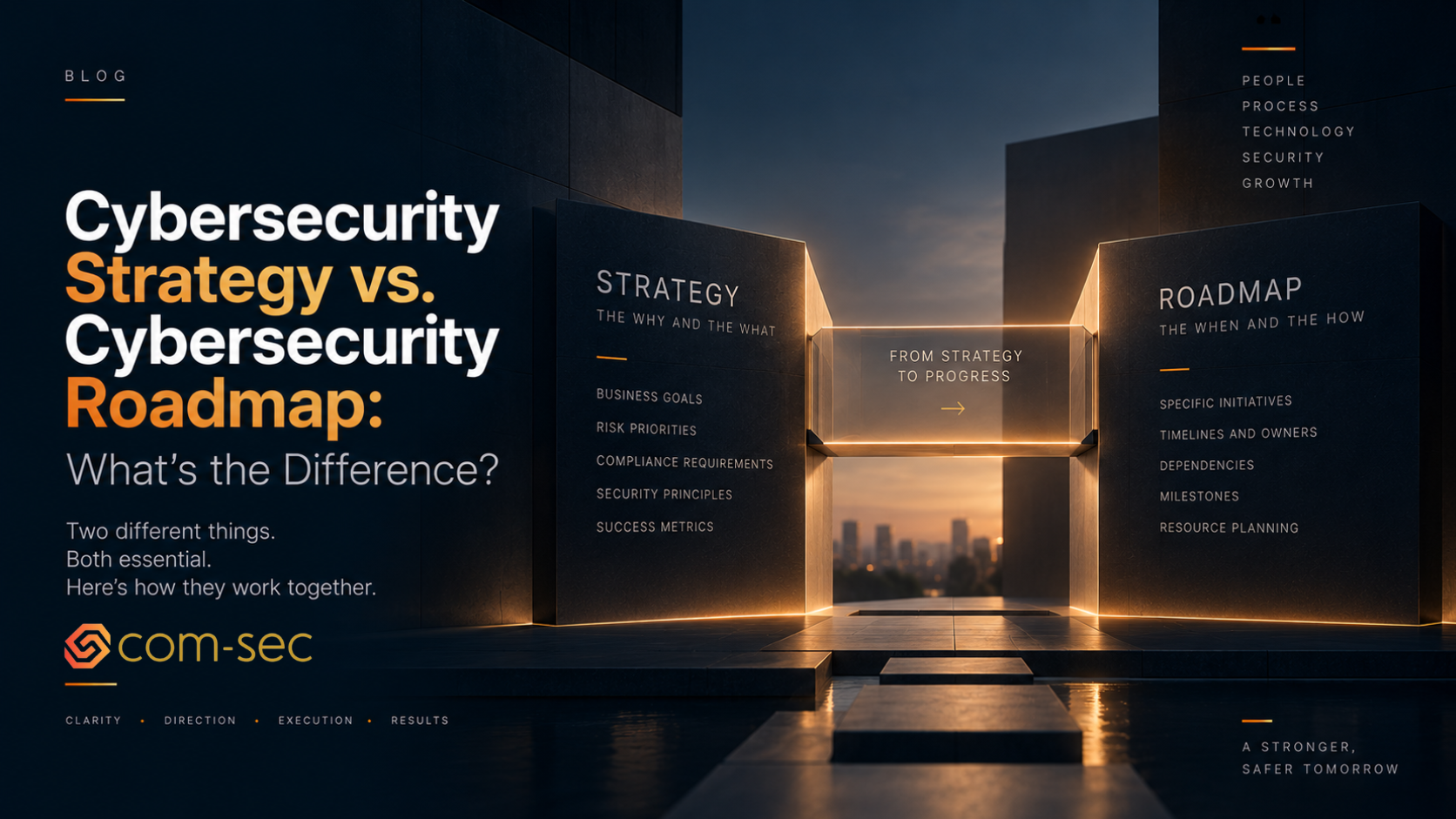
These two terms get used interchangeably. They're not the same thing. Understanding the difference matters because it determines how you plan, prioritize, and communicate about security.
The strategy: the why and the what
A cybersecurity strategy answers three questions: what are we protecting, what are the biggest risks, and how do we approach managing them?
The strategy is business-level thinking. It's informed by your company's goals, your customer requirements, your regulatory environment, your risk tolerance, and your budget constraints. It defines the direction.
A strategy might say: "We're a health tech company selling to enterprise health systems. Our security program must satisfy HIPAA, achieve HITRUST i1 certification within 18 months, and enable us to pass enterprise procurement reviews. We'll take a risk-based approach, prioritizing controls that directly enable sales and protect patient data."
That's a strategy. It doesn't tell you what to do on Monday. It tells you why you're doing anything at all and what success looks like.
The roadmap: the when and the how
A cybersecurity roadmap answers a different question: what specific things do we need to do, in what order, by when?
The roadmap is the execution plan. It takes the strategy's direction and breaks it into concrete, sequenced, time-bound initiatives with owners, dependencies, and milestones.
A roadmap might say:
Q1: Deploy MDM and EDR across all endpoints. Implement SSO with MFA. Write core policies. Set up Drata.
Q2: Complete risk assessment. Begin evidence collection. Conduct security awareness training. Start vendor reviews.
Q3: Pen test. Tabletop exercise. Internal audit. Remediate findings.
Q4: HITRUST readiness assessment. Engage assessor. Begin formal assessment.
That's a roadmap. It tells you exactly what happens when.
Why the distinction matters
Companies that confuse the two end up in one of two failure modes.
Strategy without a roadmap. Leadership has a high-level understanding of what the company needs for security. "We need SOC 2." "We should be more secure." "Our customers are asking about compliance." But nobody has translated that into a sequenced plan with milestones, owners, and deadlines. The result is good intentions and no progress.
This is the most common failure mode at startups. The founders know security matters. They've had the conversation. They may have even hired a consultant who produced a strategy document. But without a roadmap, nothing gets scheduled, resourced, or executed. Six months later, the company is in the same position.
Roadmap without a strategy. The security team is executing tasks, checking boxes, deploying tools, and running through compliance requirements. But the work isn't connected to business priorities. They're implementing controls that don't map to the risks that matter most. They're pursuing a framework that customers aren't asking for. They're spending budget on advanced capabilities while basic controls have gaps.
This happens when a company hires a security person or engages a consultant who starts doing without first understanding why. Activity replaces strategy. The program looks busy but doesn't produce business results.
How they work together
The strategy informs the roadmap. The roadmap operationalizes the strategy.
When a customer asks about your security posture, the strategy is what you tell them: "We're a SOC 2 Type II certified company with an ongoing security program managed by a dedicated security team. We're currently pursuing HITRUST certification to serve the healthcare market."
The roadmap is what your team uses to make that statement true.
When each one changes
The strategy changes when the business changes. New market, new customer segment, new regulatory requirement, acquisition, new product line. Strategy changes are infrequent, maybe once or twice a year.
The roadmap changes more often. Timelines shift. Priorities adjust. A new risk emerges that needs immediate attention. A deal requires a certification earlier than planned. An incident reveals a gap that wasn't on the roadmap. The roadmap is updated quarterly at minimum.
What a good strategy includes
Your business context: what you do, who your customers are, what data you handle, what regulations apply.
Your risk posture: the top risks to the business and your approach to managing them.
Your compliance requirements: what frameworks you need, in what order, by when.
Your security principles: how you make decisions. At Com-Sec, our principles include practical over theoretical, start simple and build, security should enable revenue, and substance over theater. Your principles should reflect how your company thinks about security.
Your success metrics: how you know the program is working. Deal velocity improvement, questionnaire response time, audit findings reduction, mean time to detect and respond.
What a good roadmap includes
Time-bound initiatives grouped into phases (typically quarters). Each initiative has an owner, a deadline, dependencies, and a definition of done. The initiatives are sequenced by priority: what must happen before what, what unblocks the most value, what has the tightest deadline.
Resource requirements: what each initiative costs in money, time, and people. This prevents the common problem of a roadmap that's technically correct but impossible to execute with the available resources.
Milestones: specific checkpoints that leadership can track. "SOC 2 readiness assessment complete by end of Q1" is a milestone. "Improve security posture" is not.
Dependencies: what needs to happen before something else can start. You can't start a SOC 2 audit without a review period of evidence. You can't run a pen test retest without first remediating the findings. The roadmap captures these dependencies so nothing gets scheduled out of order.
How to present each one
Strategy goes to leadership and the board. It's a 1 to 2 page document that explains why the company is investing in security, what the goals are, and how progress will be measured. Non-technical. Business-focused.
The roadmap goes to the team executing the work. It's a detailed plan with tasks, owners, timelines, and status tracking. It's the operating document that gets reviewed weekly and updated as things change.
A fractional CISO owns both. They present the strategy to leadership and drive the roadmap with the team. The strategy sets the direction. The roadmap makes it happen.
The bottom line
A strategy without a roadmap is a plan with no action. A roadmap without a strategy is action with no direction. You need both, and they need to be connected.
If someone asks you about your cybersecurity strategy and you can explain the business rationale, the risk priorities, and the compliance goals in 60 seconds, you have a strategy. If you can also show them a phased plan with milestones and owners that's being actively tracked, you have a roadmap. Both together is what a mature security program looks like.
Farbod Fakhrai is the founder of Com-Sec, a cybersecurity and compliance consulting firm supporting startups and growth-stage companies.