Every company that reaches a certain stage needs a security program. Not because a framework says so. Because customers start asking, deals start requiring it, and the data you're handling is too valuable to leave unprotected.
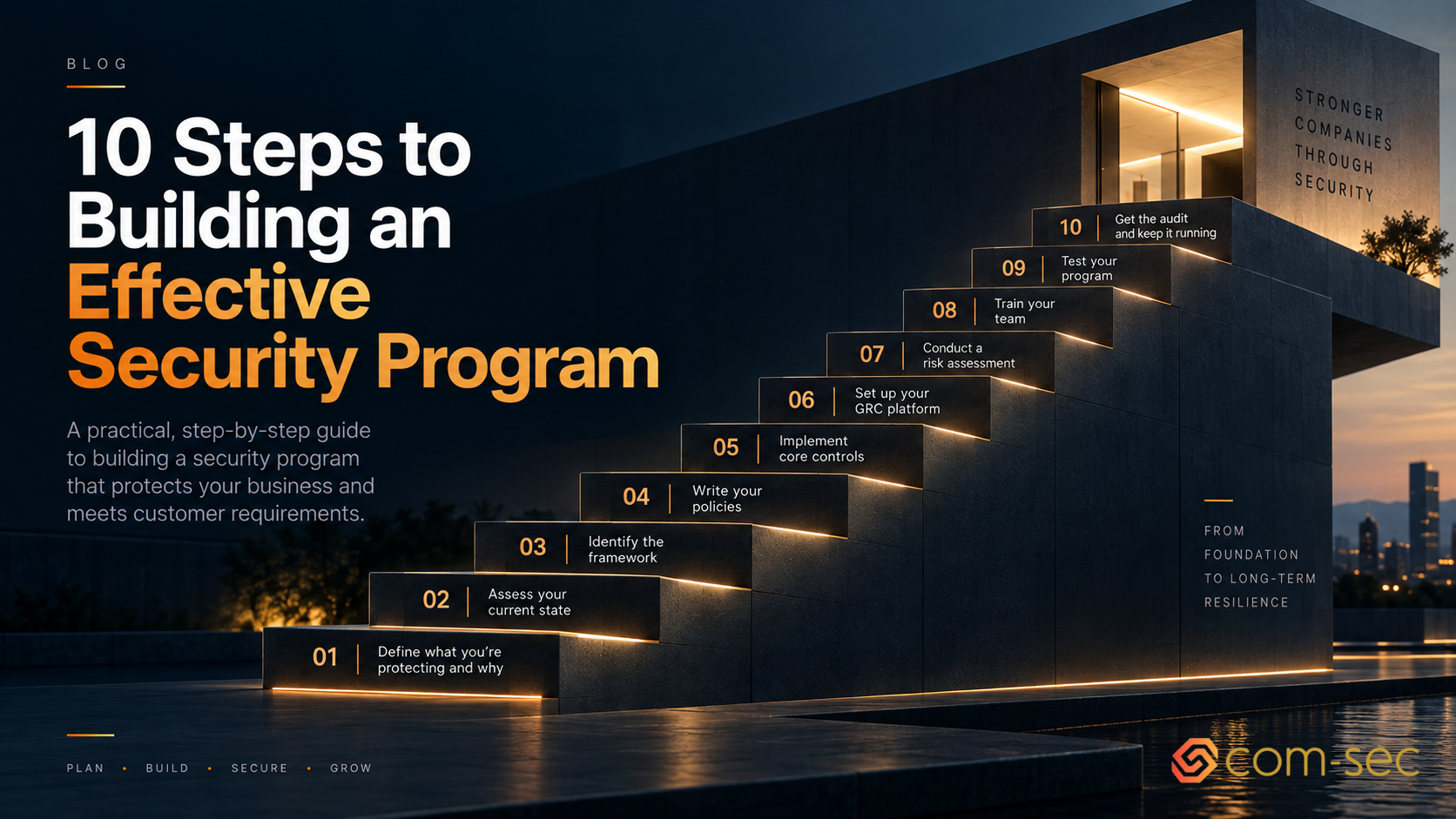
The problem is that "build a security program" sounds enormous. It's not. It's a sequence of practical steps that build on each other. Here's the order we use with every client.
Step 1: Define what you're protecting and why
Before you write a policy or buy a tool, answer two questions: what data do you handle that matters, and who would care if it was compromised?
If you're a SaaS company, you're protecting customer data, application code, and infrastructure credentials. If you're a health tech company, add PHI to that list. If you handle financial data, add PII and financial records.
The "who would care" question drives your compliance requirements. Customers care, which means SOC 2. Regulators care, which means HIPAA or applicable state laws. Investors care, which means board-level reporting.
Write it down. One page. What data, where it lives, and who cares about it. That's your scope.
Step 2: Assess your current state
You can't build a roadmap without knowing where you're starting. Do an honest assessment of what you have today.
Do you have MFA on all critical systems? Is endpoint protection deployed on every device? Do you have an offboarding process that works? Are your cloud configurations reviewed? Do you have any policies written? Have you ever done a risk assessment? Do you have cyber insurance?
Don't grade yourself generously. The gap between where you are and where you need to be is the work. Understanding it honestly saves time and money.
Step 3: Identify the framework
Pick the compliance framework that matches your customer requirements. For most startups selling to enterprise customers, that's SOC 2. For health tech, add HIPAA and potentially HITRUST. For companies with European customers, ISO 27001.
Don't try to do all of them at once. Pick the one your customers are asking for right now and build to that standard. The frameworks overlap significantly, so building for SOC 2 gets you 60 to 70% of the way to ISO 27001 and HITRUST.
If nobody is asking for a specific framework yet, build to SOC 2 Trust Services Criteria anyway. It's the most common requirement and provides a solid foundation that maps to everything else.
Step 4: Write your policies
Policies define what your company does for security. Not aspirational goals. What you actually do today, written down in a form your auditor can evaluate and your team can follow.
Start with the essentials: information security policy, access management, change management, incident response, acceptable use, data classification, vendor management, and business continuity. If you use AI tools, add an AI governance section to your acceptable use policy.
Use your GRC platform's templates as a starting point, but rewrite them to reflect your actual environment. Use your real tool names, your real role titles, and your real cadences. A policy that describes a company you don't recognize isn't a policy. It's fiction.
Step 5: Implement the core controls
Controls are the things you do to enforce your policies. These are the non-negotiables that every security program needs from day one:
MFA on every system that supports it. Phishing-resistant MFA (FIDO2, passkeys) for admin accounts. Endpoint protection (EDR) on every device. Device management (MDM) with encryption enforced. Centralized access management through SSO where possible. Automated offboarding that revokes access within 24 hours. Centralized logging for critical systems. Encrypted data at rest and in transit. Regular patching and vulnerability scanning.
None of these are exotic. None of them require enterprise budgets. They're the basics, and they stop the majority of attacks that target companies your size.
Step 6: Set up your GRC platform
Drata, Vanta, or Rippling. Pick one. Connect it to your cloud environment, identity provider, HR system, and endpoint management platform. It automates evidence collection for your compliance framework, monitors your controls continuously, and keeps your auditor happy.
The platform is a tool, not a strategy. It collects evidence that your controls are operating. It doesn't design the controls, implement them, or decide what matters. That's your security team's job (or your vCISO's job).
Set it up early so evidence is collecting throughout your review period. An auditor can't evaluate controls that weren't monitored.
Step 7: Conduct a formal risk assessment
Now that you have controls in place, do a formal risk assessment. Identify the threats relevant to your business, assess the likelihood and impact of each, evaluate whether your current controls adequately mitigate them, and document your risk treatment decisions.
This is a compliance requirement for SOC 2, ISO 27001, HIPAA, and HITRUST. But it's also genuinely useful. A well-done risk assessment tells you where your remaining gaps are and what to prioritize next.
Review it annually and update it when your environment significantly changes.
Step 8: Train your team
Security awareness training is a compliance requirement and a practical necessity. Every employee should complete training within 30 days of hire and annually thereafter.
Cover the basics: phishing recognition and reporting, password management, device security, data handling, acceptable use, and incident reporting. For roles with elevated access or specific risk profiles (engineering, finance, executive), add targeted training.
Run phishing simulations quarterly. Measure reporting rates, not just click rates. An employee who clicks but reports immediately is more valuable than one who ignores the email entirely.
Step 9: Test your program
You've built the controls, written the policies, set up monitoring, trained the team. Now test it.
Run a penetration test. Have an external firm attempt to find vulnerabilities in your application and infrastructure. Fix the critical and high findings. Retest to verify.
Run an incident response tabletop. Walk your team through a realistic scenario and see where the plan breaks down. Update the plan based on what you learn.
Run your first internal audit if you're pursuing ISO 27001. Review your controls against the standard and identify gaps before the certification auditor does.
Step 10: Get the audit and keep the program running
Schedule your SOC 2, ISO 27001, or HITRUST assessment. Your GRC platform has been collecting evidence. Your controls have been operating. Your policies are current. Your risk assessment is documented. You're ready.
The audit itself typically takes 4 to 8 weeks. Your security team or vCISO coordinates with the auditor, handles evidence requests, and manages follow-ups. The output is a report you can share with customers.
Then the real work begins: keeping the program running. Access reviews every quarter. Policy reviews annually. Continuous monitoring through your GRC platform. Annual pen tests. Annual risk assessment updates. Regular training. Ongoing vendor reviews.
A security program isn't a project with an end date. It's an ongoing operation. The companies that treat it that way have clean audits, fast questionnaire responses, and security programs that actually protect the business.
Farbod Fakhrai is the founder of Com-Sec, a cybersecurity and compliance consulting firm supporting startups and growth-stage companies. com-sec.com