Most companies don't need a full-time CISO. What they need is someone who can walk in, assess the situation, and build a security strategy that actually fits the business. That's what a fractional CISO does.
But "build a cybersecurity strategy" is one of those phrases that sounds important and means nothing until someone explains what it looks like in practice. So here's exactly how we do it.
The first two weeks: understand the business
A cybersecurity strategy that doesn't start with the business isn't a strategy. It's a checklist.
Before we touch a single tool, policy, or framework, we need to understand what the company does, how it makes money, what data it handles, who its customers are, and what keeps leadership up at night.
For a health tech company selling to hospital systems, the strategy looks completely different than for a fintech startup selling to SMBs. The health tech company needs HIPAA, probably HITRUST, and has to satisfy procurement teams at large health systems that ask 300 questions about how patient data is protected. The fintech company needs SOC 2, possibly PCI-DSS, and has to pass security reviews from banking partners.
Same title: "cybersecurity strategy." Completely different substance.
In the first two weeks, a fractional CISO should be doing four things:
- Meeting with leadership to understand business goals, revenue model, customer base, growth plans, and regulatory requirements. Not a security questionnaire. A business conversation.
- Mapping the technology environment. What cloud providers, what SaaS tools, what infrastructure, what code repositories, what databases. Where does customer data live, how does it flow, and who has access.
- Identifying the compliance requirements. What frameworks do customers require? What regulations apply? What's been promised in sales conversations that hasn't been delivered yet?
- Understanding the team. Who touches security today? Is there an IT person, an MSP, an engineer who got voluntold into security? What's their capacity? What do they know? What's falling through the cracks?
Week three: the risk assessment
This is where a lot of fractional CISOs go wrong. They skip the risk assessment and jump straight to recommending tools and frameworks. That's backwards.
A risk assessment answers: what are the specific threats to this company, how likely are they, and what would the impact be? Not theoretical threats from a textbook. Actual threats relevant to this company's size, industry, technology, and customer base.
For a 30-person SaaS company, the top risks are usually: compromised credentials leading to cloud environment access, phishing leading to business email compromise or wire fraud, a data breach affecting customer data, loss of a key compliance certification, and a ransomware event affecting business operations.
For each risk, we assess likelihood and impact, then prioritize. Not every risk needs immediate attention. Some are high likelihood but low impact. Some are low likelihood but catastrophic. The strategy allocates resources to the risks that matter most.
The output is a risk register that leadership can actually read. Not a 50-page document with color-coded heat maps. A clear list of risks, ranked by priority, with recommended controls and estimated costs.
Month one: the security roadmap
The risk assessment tells you what to fix. The roadmap tells you when and in what order.
A good roadmap has three horizons:
- Now (0 to 90 days): the non-negotiables. These are the controls that address your highest risks and your most immediate compliance requirements. MFA everywhere. Endpoint protection on every device. Access reviews. Offboarding process. Incident response plan. Basic policies. If you have a SOC 2 audit in 6 months, the GRC platform setup and evidence collection starts here.
- Next (90 to 180 days): build the program. Vendor risk management. Security awareness training. Vulnerability scanning cadence. Pen test. Formal risk assessment documentation. Board or investor reporting framework. Compliance framework alignment. This is where the program goes from reactive to structured.
- Later (180+ days): mature and expand. Additional certifications (ISO 27001, HITRUST). Advanced monitoring and detection. AI governance. Zero trust architecture. Disaster recovery testing. These are investments that make sense once the foundation is solid.
The roadmap is a living document. It changes as the business grows, as customer requirements evolve, and as new risks emerge. A fractional CISO reviews and adjusts it quarterly.
The ongoing work
Strategy isn't a deliverable. It's an operating model.
After the initial assessment and roadmap, the fractional CISO's ongoing work includes: driving execution of the roadmap week by week, managing the compliance program (evidence collection, policy maintenance, audit coordination), responding to security questionnaires from customers, advising leadership on security investment decisions, managing vendor risk, coordinating incident response when something happens, running tabletop exercises, overseeing pen tests and vulnerability management, and reporting to the board or investors on security posture.
This is 10 to 20 hours per week for most companies in the 20 to 150 employee range. It's not a monthly check-in. It's embedded, consistent engagement that keeps the program moving.
What makes a fractional CISO's strategy different from a consultant's
A consultant delivers a report. A fractional CISO delivers results.
The consultant comes in, does an assessment, writes a 60-page document with recommendations, and leaves. The company reads the executive summary, feels overwhelmed by the 47 recommendations, and puts the report in a drawer. Nothing changes.
A fractional CISO does the assessment, builds the roadmap, and then executes it. They're accountable for the outcomes, not just the recommendations. They show up every week, drive the work forward, and adjust the strategy as the business evolves.
The strategy doesn't live in a PDF. It lives in the security program that's operating week to week.
How to evaluate whether the strategy is working
Three questions to ask your fractional CISO quarterly:
- Are we closer to our compliance goals than we were 90 days ago? If you needed SOC 2 and you're 90 days closer to having it, the strategy is working. If you're in the same place, something's off.
- Are security questionnaires getting easier? If your team can answer customer security questions faster and more completely than they could before, the program is maturing. If every questionnaire is still a fire drill, the strategy hasn't translated into operational readiness.
- Can you articulate our risk posture to a non-technical person in 60 seconds? If the fractional CISO can clearly explain what your top risks are, what you're doing about them, and what's next, the strategy is coherent. If the answer is jargon and hand-waving, the strategy isn't grounded in the business.
The cost
Fractional CISO engagements typically run $3,000 to $8,000 per month depending on scope, complexity, and the number of frameworks being managed. Compare that to a full-time CISO at $250,000 to $350,000 in total compensation.
The fractional model gives you experienced security leadership with breadth across industries and company stages. You get someone who's seen 50 environments, not just yours, and can apply patterns and lessons from all of them.
The bottom line
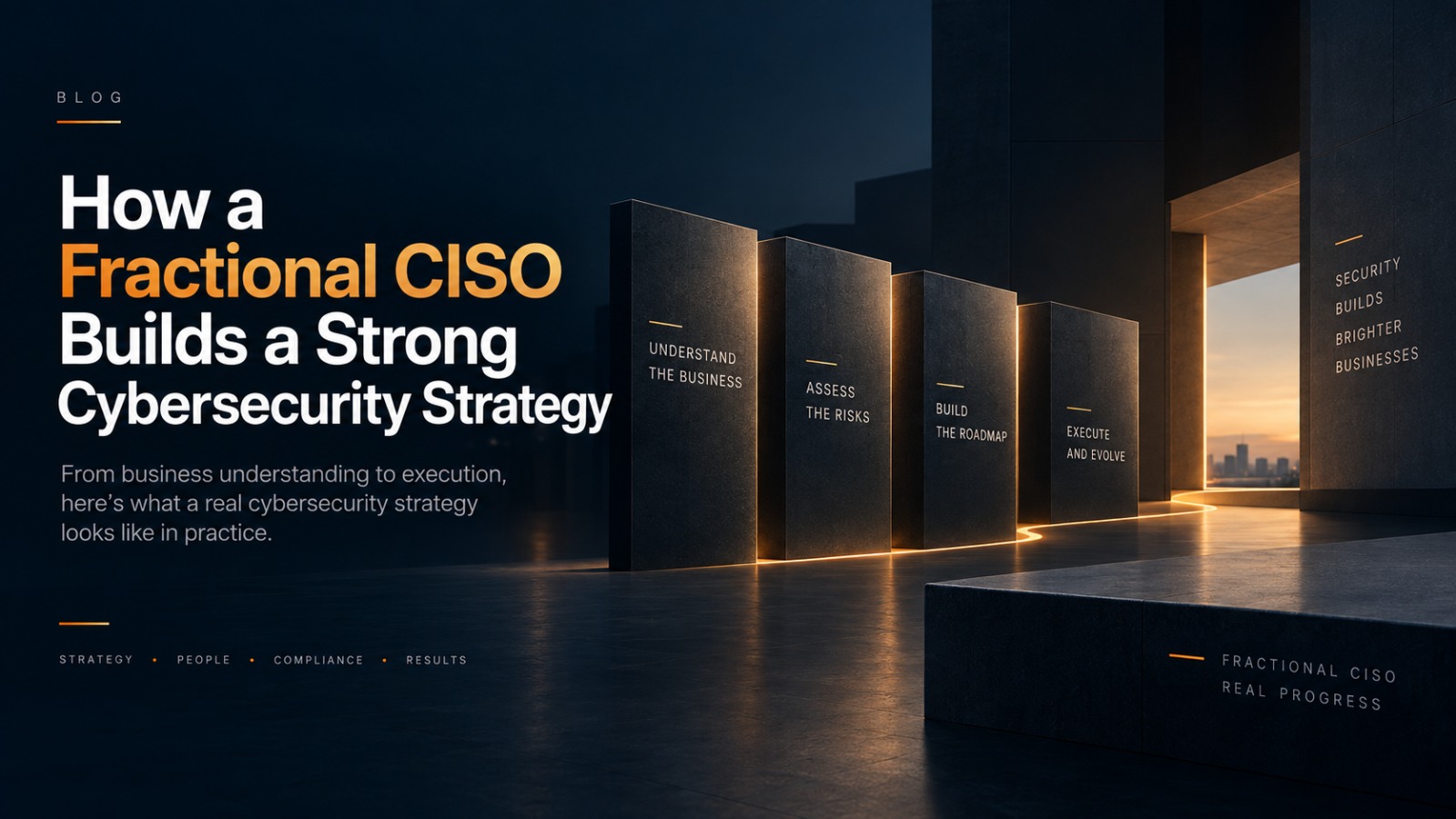
A strong cybersecurity strategy isn't a document. It's a business-aligned, risk-informed operating model that evolves with the company. A fractional CISO builds it by understanding the business first, assessing the real risks, creating a prioritized roadmap, and then executing it week by week.
If your current security strategy is a PDF that nobody's read since it was written, it's not a strategy. It's a file. The difference is someone who owns it and keeps it alive.
Farbod Fakhrai is the founder of Com-Sec, a cybersecurity and compliance consulting firm supporting startups and growth-stage companies. Learn more at com-sec.io.