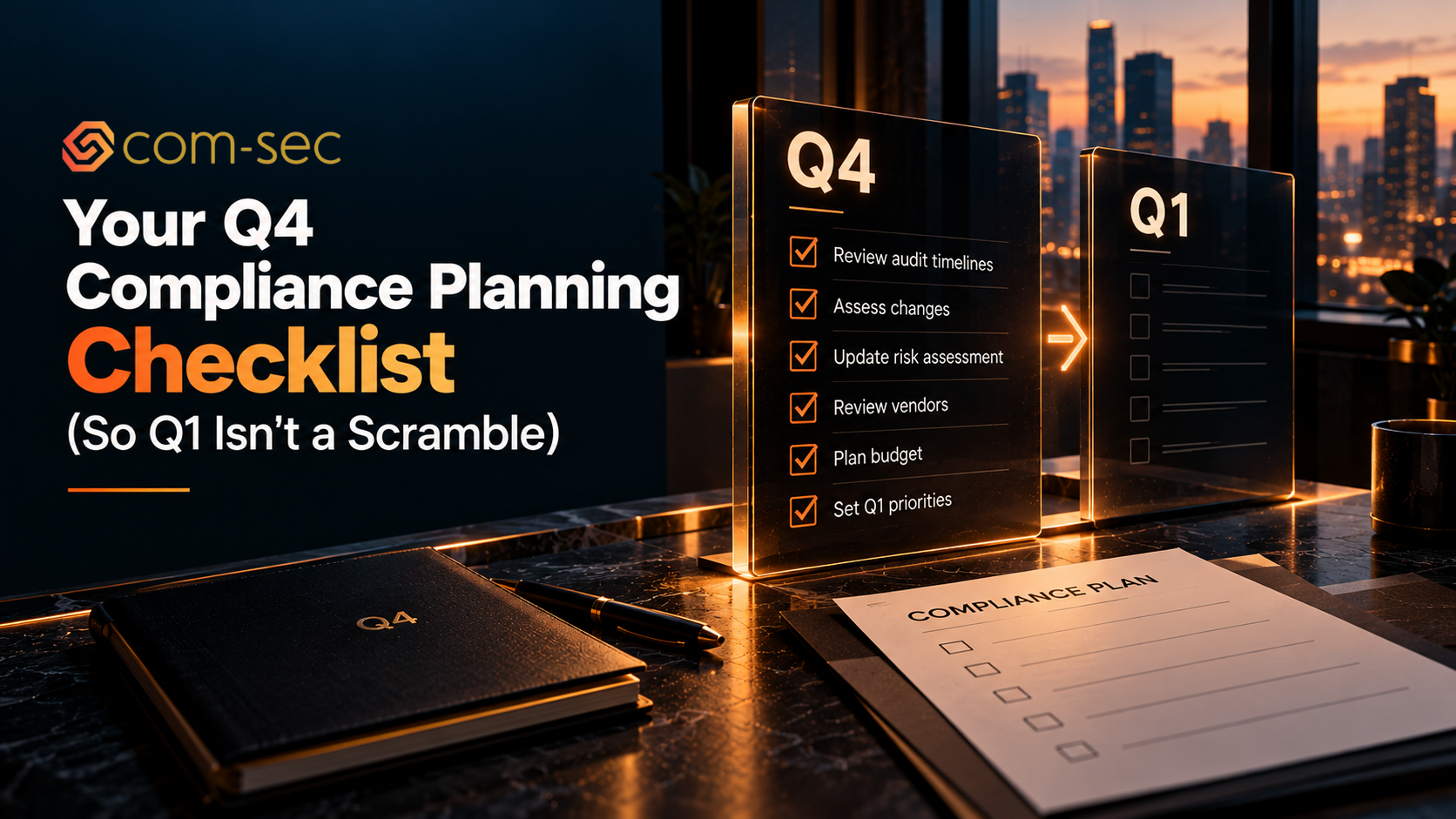
Every year, the same thing happens. Companies spend Q4 focused on revenue targets, year-end priorities, and planning for the next year. Security and compliance get pushed to January. Then January arrives, and suddenly everything is urgent: the SOC 2 audit window is approaching, the risk assessment is stale, the vendor reviews are overdue, and the budget for that security tool you needed was never approved.
Q4 is the time to set up Q1 for success. Here's how.
Review your certifications and audit timelines
If you have SOC 2 Type II, when does your current audit period end? When does your next audit period start? Is your auditor confirmed? Have you locked in dates?
If your audit period ends in Q1, you should be in evidence collection mode right now. Not in January. Now.
If you're approaching your first SOC 2, or transitioning from Type I to Type II, Q4 is when you should be finalizing your readiness assessment and locking in your audit firm. Good auditors book up early in the year.
Same goes for ISO 27001 surveillance audits, HITRUST assessments, and HIPAA risk assessments. Know your dates. Work backward from them.
Assess what changed this year
Your environment isn't the same as it was in January. You've probably:
- Added new SaaS tools and integrations
- Onboarded new employees and maybe offboarded others
- Changed cloud infrastructure
- Adopted AI tools across the team, approved or not
- Added new customers with new compliance requirements
- Changed your product in ways that affect data handling
Each of these changes has compliance implications. A new integration might need to be added to your vendor inventory. A product change might affect your data flow diagrams. New AI tool adoption needs to be reflected in your policies.
Do a quick environmental scan now so you're not discovering these gaps during your audit.
Update your risk assessment
If your risk assessment is more than 12 months old, it's due for an update. If it's more than 6 months old and your environment has changed significantly, it's still due.
A risk assessment doesn't have to be a massive exercise. Review your threat landscape. Have new risks emerged (AI-driven attacks, supply chain compromises, new regulatory requirements)? Have existing risks changed in likelihood or impact? Are your current controls still adequate?
Update your risk register. Score the risks. Make sure your treatment plans are current. This is one of the first things an auditor looks at, and it's one of the most common findings when it's stale.
Review your vendor inventory
When was the last time you reviewed your critical vendors? Do you have current SOC 2 reports or security assessments for each one? Have any of your vendors had security incidents this year?
Vendor management is one of those compliance requirements that's easy to set up and easy to neglect. Q4 is a good time to:
- Request updated SOC 2 reports from critical vendors
- Review any vendors you added this year that haven't been assessed
- Re-evaluate vendor risk ratings based on any incidents or changes
- Remove vendors you're no longer using
Budget for security in the new year
If you need a security tool, a GRC platform, a penetration test, or advisory support, the budget request needs to happen in Q4 for most companies. Waiting until Q1 to ask for budget means you won't have the tool until Q2, and by then you're behind.
Common items that need budget allocation:
- Annual penetration testing
- GRC platform subscription (Drata, Vanta, Secureframe, etc.)
- Security awareness training platform
- Endpoint protection / EDR licensing
- Cloud security posture management
- Virtual CISO or security advisory services
- Bug bounty or vulnerability research program
- Incident response retainer
If your security budget is zero, that's worth a conversation with your leadership team. Security isn't free, but the cost of a breach is orders of magnitude higher than the cost of prevention.
Set Q1 priorities
Don't wait until January to decide what matters most. Based on your audit timeline, risk assessment, and business objectives, identify your top three security and compliance priorities for Q1. Write them down. Share them with your team. Make them specific and time-bound.
Examples:
- Complete SOC 2 Type II audit by March 31
- Implement MFA across all production and admin systems by February 15
- Conduct annual penetration test by end of February
- Roll out AI acceptable use policy and training by January 31
- Complete vendor risk reviews for all critical vendors by March 15
The payoff
Companies that do this work in Q4 start Q1 with clarity and momentum. Companies that don't start Q1 with a pile of overdue compliance work, no budget, and an audit deadline breathing down their necks.
The difference between a smooth audit season and a stressful one is almost always preparation. And preparation happens in Q4.
If you need help building your Q1 compliance plan or getting ready for an upcoming audit, reach out. That's exactly what we do.
Farbod Fakhrai is the founder of Com-Sec, a cybersecurity and compliance consulting firm for startups and growth-stage companies. com-sec.com