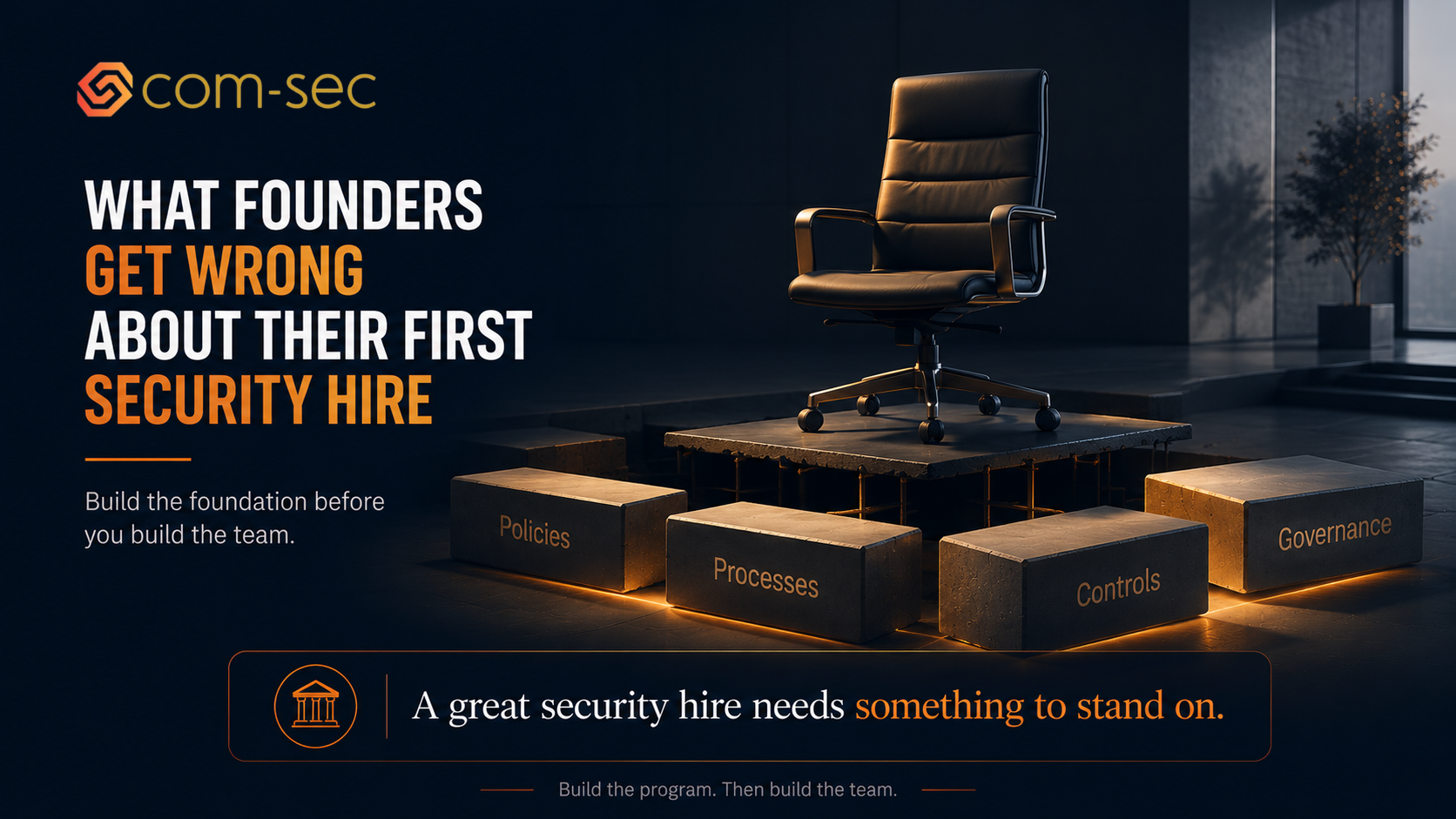
At some point, usually when a customer asks a hard question or an audit is looming, every founder has the same thought: "We need to hire a security person."
The instinct is right. The execution is usually wrong.
Mistake 1: Hiring too late
By the time most startups hire for security, they've already accumulated years of technical debt, unmanaged access, no logging, default configurations, and a pile of security questionnaires answered by someone who Googled the answers. The first hire spends their first six months cleaning up instead of building.
Start thinking about security earlier than you think you need to. Not necessarily a hire, but at least a structured program.
Mistake 2: Hiring the wrong profile
A common pattern: the founder posts a "Head of Security" job, gets a former enterprise CISO who's managed 50-person teams at a Fortune 500, and hires them to run security at a 40-person startup. It doesn't work. The skill set is different. Startup security is hands-on. You need someone who can write a policy, configure an MDM, answer a questionnaire, prep for an audit, and explain risk to the board, often in the same week.
The best first security hire is a generalist who's comfortable operating across compliance, IT security, and risk management. Not a specialist in one domain.
Mistake 3: Buying tools before defining the process
"We need a SIEM" is usually the wrong first move. So is "we need a vulnerability scanner" or "we need a compliance platform." Tools are useful when they support a defined process. Without the process, they generate noise, cost money, and create a false sense of security.
Define what you're trying to accomplish first: access management, endpoint protection, audit readiness, incident response. Then pick the tools that support those processes. The order matters.
The case for fractional first
For most companies between 10 and 100 employees, a full-time CISO is premature. You don't have enough work to keep them busy 40 hours a week, and good ones are expensive.
A fractional or virtual CISO gives you experienced security leadership at a fraction of the cost. They can build the program, handle compliance, answer customer questionnaires, and coordinate with auditors. When you've grown enough that security needs a full-time person, the vCISO has already built the foundation they'll operate on.
This isn't a pitch for Com-Sec (well, maybe a little). It's genuinely the right model for most startups. I've seen it work dozens of times.