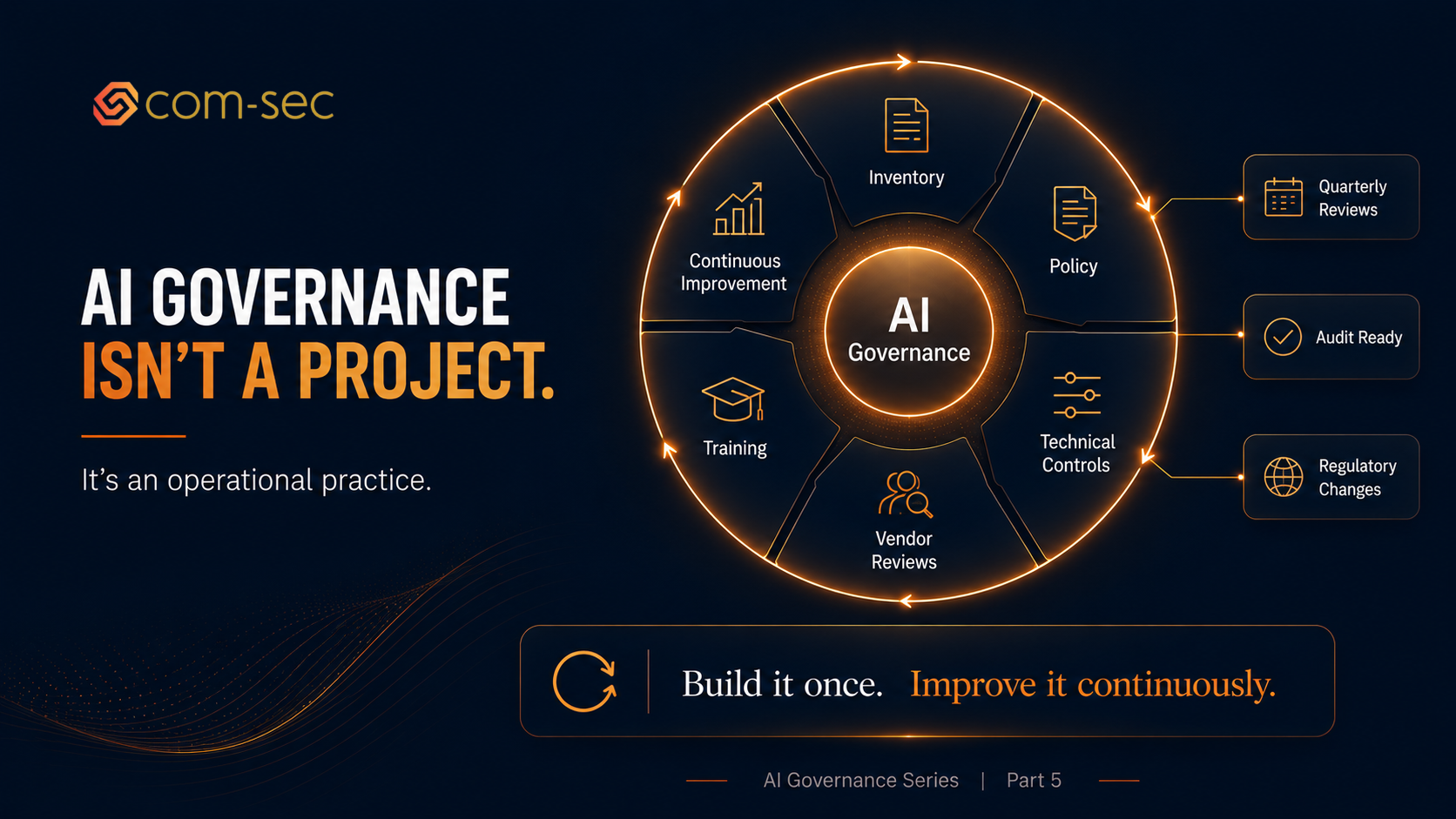
Building an AI governance program takes a few weeks. Keeping it running is the actual work. Here's how to operationalize it so it doesn't decay.
Quarterly review cycle
Every quarter, review four things:
Tool inventory. Has anything been added? Are there new AI tools in use that haven't been evaluated? Has any approved tool changed its data handling, BAA coverage, or capabilities? Run a quick resurvey or check your SSO logs.
Policy currency. Does the acceptable use policy still reflect reality? Are the approved tools and tiers still accurate? Have any new regulations or customer requirements emerged that require policy updates?
Incident review. Were there any AI-related incidents, near-misses, or policy violations? What happened, what was the root cause, and what changed as a result?
Vendor AI changes. Have any of your vendors introduced new AI features or changed how they process your data with AI? This is increasingly common and often announced in changelog updates that nobody reads.
Assign ownership
Someone owns this program. A vCISO, a security lead, a compliance manager. Whoever it is, they need time allocated to AI governance specifically. It's not a full-time job, but it's a real responsibility that requires 2 to 4 hours per week: processing tool approval requests, monitoring for shadow AI, coordinating with vendors, and keeping the inventory and policy current.
If nobody owns it, entropy takes over and within 6 months your inventory is outdated, your policy doesn't reflect what people are actually using, and your enterprise customers get answers to AI governance questions that don't hold up.
Training cadence
Initial training during rollout. Refresher during onboarding for new hires. Annual refresher for the full company. Ad hoc updates when something significant changes: a new tool approved, new restrictions, a policy update, a regulatory change.
Keep it short. 15 to 30 minutes. Focus on what changed and why. People tune out long training sessions.
Preparing for audits
SOC 2 auditors are asking about AI. ISO 27001 auditors are asking about AI. HITRUST assessors are asking about AI. Enterprise customers are adding AI-specific sections to security questionnaires.
Have your evidence ready: AI tool inventory, acceptable use policy, data classification for AI, training records, vendor AI assessments, incident logs, and quarterly review documentation. If you've been running the program as described in this series, you already have all of it.
For companies pursuing ISO 42001 (the AI management system standard), the governance program we've described maps directly to the standard's requirements. You're not starting from zero.
Preparing for regulation
The EU AI Act is in effect. State-level AI laws are proliferating in the US. Sector-specific AI guidance is coming from HHS, the FDA, financial regulators, and others. The regulatory landscape is moving fast and it's moving toward more oversight, not less.
The companies that have a documented, operational AI governance program will adapt to new requirements incrementally. The ones that don't will face expensive, rushed compliance projects when a regulation hits or a customer demands it.
The bottom line
AI governance is not a project with an end date. It's an operational practice, like vulnerability management or access reviews. Build it once, run it continuously, and improve it as the technology and regulatory landscape evolve.
The companies that build this muscle now will be in a fundamentally stronger position than the ones that wait.
Series complete
That wraps up the 5-part series on implementing an AI governance model. Catch up on any part you missed below, or reach out if you're ready to put this into practice.