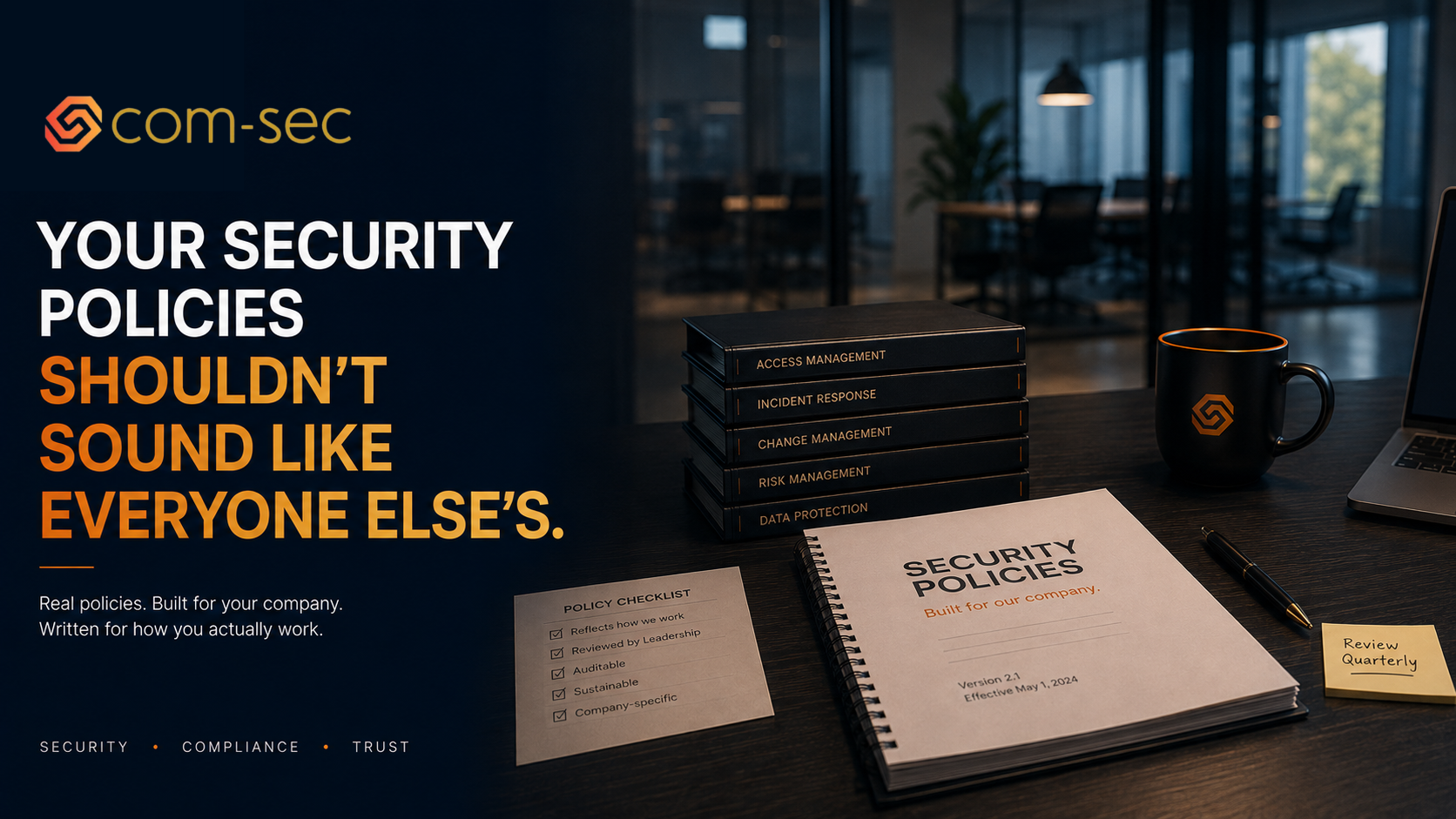
Every GRC platform ships with policy templates. Drata has them. Vanta has them. Rippling has them. They're one of the first things a company enables when they start SOC 2 readiness . Click a button, generate 15 policies, check the box, move on.
Six months later the auditor asks: "Walk me through your access management process."
The CTO opens the access management policy for the first time since it was generated, reads a paragraph that could describe any company on earth, and says: "Uh, yeah, that's basically what we do."
That's the problem. Template policies describe a generic company. Your auditor is evaluating your company. Your customers are reading your policies to understand how you operate. If the policy doesn't match reality, it fails at both jobs.
The difference between a policy and a process
This is where most companies get confused, and where template policies make it worse.
A policy. A statement of intent. It defines what the company will do and why. It sets the standard. It's approved by leadership and reviewed periodically. It changes infrequently. Example: “All employees must use multi-factor authentication to access company systems containing customer data.”
A process (or procedure). Describes the specific steps to implement the policy. It's operational. It changes more frequently as tools and workflows evolve. Example: “MFA is enforced through Okta. New employees are enrolled during onboarding by the IT team. Enrollment is verified within 48 hours. Exceptions require written approval from the security lead and are reviewed quarterly.”
A standard. Sits between the two. It defines the specific technical requirements that implement the policy. Example: “MFA must use TOTP or FIDO2. SMS-based MFA is not permitted for accounts with admin access.”
Most template policies blur these together. You end up with a 15-page document that's part policy, part procedure, part aspirational statement, and part copy-paste from a framework. Nobody reads it. Nobody follows it. It exists to satisfy an auditor checkbox.
Why templates aren't enough
Templates are a starting point. A good one saves you time by giving you the structure and the framework-aligned language. But a template becomes a liability when you publish it without making it yours.
Templates describe controls you might not have. The template says you have a formal change management process with peer review, testing, and approval gates. Your actual process is engineers merging their own PRs after a Slack thumbs-up. The policy says one thing. Reality says another. The auditor tests reality.
Templates commit you to things you can't sustain. The template says access reviews are performed monthly. You can barely do them quarterly. Now you've committed to a control in writing that you're going to fail every single month. You wrote your own exception.
Templates use language that doesn't match your company. The template references “the Information Security Committee” and “the Chief Information Security Officer.” You have 20 employees and a part-time vCISO. The policy sounds like it was written for a bank. Your auditor knows you're not a bank.
Templates miss what's unique about your environment. Your company uses AI in its product. Your template policies don't mention AI governance, model validation, or prompt security. Your company is fully remote with no office. Your template physical security policy describes badge access and visitor logs for a building that doesn't exist.
What should actually go in your policies
Keep policies short, specific to your company, and honest about how you actually operate. Here's what each core policy should cover:
Information Security Policy. The umbrella. States your commitment to protecting information assets. Defines the scope (what systems, what data, what people). Names who's responsible (usually the CEO or security lead, not an imaginary committee). References the other policies. This one can be 2 to 3 pages.
Access Management Policy. How access is granted, reviewed, and revoked. Who approves access requests. What the review cadence is (quarterly is standard and sustainable for most companies). How quickly access is revoked on termination (24 hours is common, but only commit to what you can actually do). MFA requirements. Password requirements if applicable. Shared account restrictions.
Change Management Policy. How code and configuration changes move from development to production. Whether peer review is required (and for what types of changes). How emergency changes are handled. How changes are tracked and documented. If your actual process is pull requests with one approval in GitHub, say that.
Incident Response Policy. What constitutes a security incident. Who to contact first (insurance carrier, vCISO, IT). Roles and responsibilities during an incident. Containment procedures. Communication protocols (internal, customer, regulatory). Post-incident review process. Include actual names, actual phone numbers, actual escalation paths — a policy that says “contact the incident response team” is useless at 2am.
Acceptable Use Policy. What employees can and can't do with company systems and data. Covers personal use of company devices, prohibited activities, data handling expectations, social media guidelines, and AI tool usage. This is where your AI governance rules live: which AI tools are approved, what data can and can't go into AI tools, human review requirements for AI-generated outputs, and agentic tool restrictions.
Data Classification Policy. How your company categorizes data (public, internal, confidential, restricted). What protections apply to each level. How data is stored, transmitted, and disposed of. Four levels with clear definitions and handling requirements is sufficient for most companies.
Vendor Management Policy. How vendors are evaluated before onboarding. What due diligence is required (SOC 2 review, security questionnaire, BAA for healthcare data). How often vendors are reviewed. How vendor incidents are handled.
Business Continuity and Disaster Recovery Policy. Your RTOs and RPOs (recovery time and recovery point objectives). Backup strategy. What happens if your primary cloud region goes down. Who makes the call to activate DR. How you communicate with customers during an outage.
Risk Management Policy. How you identify, assess, and treat risks. Who owns the risk register. How often risks are reviewed. Your risk appetite (what level of risk is acceptable). How risk treatment decisions are documented.
Don't write: "Access is granted based on the principle of least privilege following a formal request and approval process involving the hiring manager, IT department, and information security team."
Write: "Access is requested through [your actual ticketing system or process]. The employee's manager approves. IT provisions access within [your actual timeline]. Access is limited to what the role requires."
The first one sounds professional and describes no company in particular. The second one is auditable.
How to make policies your own
- Start with the template, then rewrite every section. Read each paragraph and ask: does this describe how we actually work? If not, rewrite it. If you don't do something the template describes, remove it or replace it with what you actually do.
- Use your actual tool names. Don't say “the company's endpoint detection solution.” Say “CrowdStrike” or “SentinelOne.” Specific tools make the policy auditable and demonstrate that you've actually implemented the controls.
- Use your actual role titles. Don't say “the Chief Information Security Officer” if you have a vCISO. Say “the vCISO” or “the security lead.” Don't reference committees that don't exist.
- Commit only to what you can sustain. A policy you follow consistently is infinitely more valuable than an ambitious policy you violate every month.
- Include your AI governance. If you use AI tools internally, your policies should address approved tools, data classification for AI, human oversight requirements, and agentic tool restrictions. This is table stakes in 2026.
- Keep them short. A 20-page policy that nobody reads is worse than a 3-page policy that everyone follows.
- Date and version them. Every policy should have a version number, a last-reviewed date, and an owner.
The review cadence
Review policies annually at minimum. The review doesn't mean rewriting everything. It means reading each policy, confirming it still reflects reality, updating anything that's changed (tools, processes, roles, regulatory requirements), and documenting that the review happened.
Some triggers for an off-cycle review: you change cloud providers, you add a major new tool, you start operating in a new market (healthcare, EU), you have a security incident, your team grows significantly, or a regulatory change affects your obligations.
What your auditor actually wants to see
Auditors don't want perfect policies. They want accurate policies.
A policy that says you do quarterly access reviews and you have evidence of four quarterly access reviews during the review period is a clean control. A policy that says you do monthly access reviews and you have evidence of four reviews is an exception in 8 out of 12 months.
The auditor tests your controls against what your policy says. Write the policy to match what you actually do, then do it consistently. That's the entire game.
What we do
We write and maintain policies for our clients as part of our vCISO and compliance management services. We start with industry-standard templates, then rewrite them to match how your company actually operates.
We use your tools, your roles, your processes, and your cadences.
When your environment changes, we update the policies. When your auditor asks about a policy, we can walk them through it because we wrote it based on the real controls we helped implement.
Template policies get you started. Custom policies get you through the audit without exceptions you wrote yourself.
Farbod Fakhrai is the founder of Com-Sec, a cybersecurity and compliance consulting firm supporting startups and growth-stage companies.