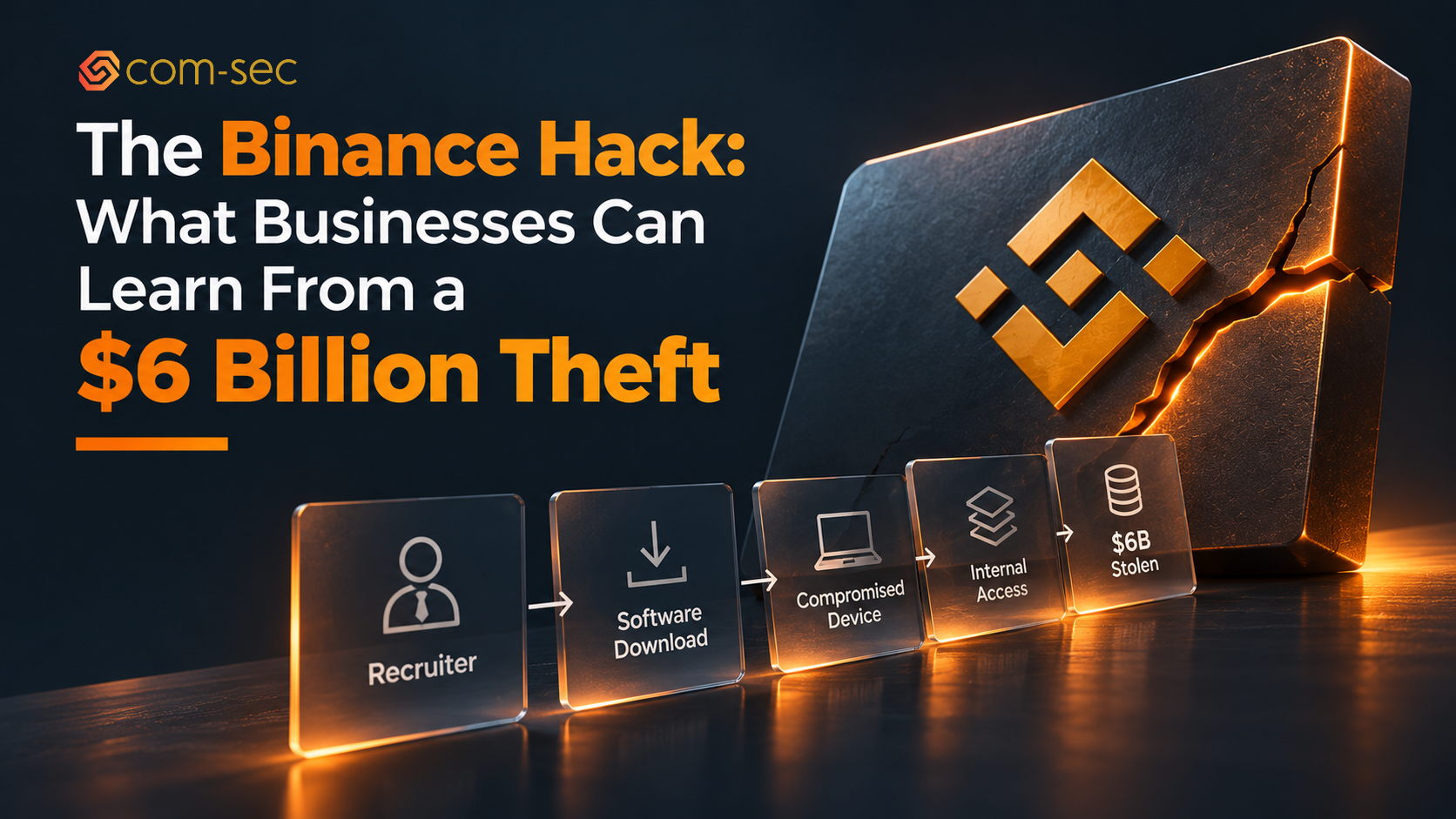
A convincing recruiter. A software download. An employee's computer.
Those are familiar parts of everyday work. According to Binance's preliminary investigation, they were also pieces of an attack chain that ended with billions of dollars leaving its cryptocurrency wallets.
The FBI attributed the theft of more than $6 billion from Binance, on or about October 29, 2026, to North Korea's TraderTraitor group. The investigation is ongoing, and the technical account may change as more evidence becomes available. FBI announcement
For businesses outside cryptocurrency, the useful question is straightforward: what could an attacker reach after compromising one employee's device?
HOW THE ATTACK DEVELOPED
Binance's preliminary findings describe a campaign involving fake recruitment interviews, malicious software downloads, compromised employee endpoints, and internal AI tooling. The company also identified abuse of transaction authorization as part of the theft.
Its account places an initial compromise months before the funds moved. That matters because an attacker does not need to cause immediate disruption to be dangerous. Access can give them time to understand systems, identify valuable permissions, and prepare their next move. Binance's preliminary findings
This was a broader intrusion than a typical business email compromise involving fraudulent payment instructions. It nevertheless highlights a similar weakness: people and systems can act on a request that appears trustworthy without independently establishing that it is legitimate.
A FAMILIAR CONVERSATION CAN BECOME AN ENTRY POINT
Recruiting conversations often involve unfamiliar people, meeting links, technical assessments, and requests to try software. That creates opportunities for an attacker to introduce a malicious download inside an otherwise plausible interaction.
Businesses should give employees clear guidance on handling those requests, particularly on company devices. A developer should know where to ask before installing an unfamiliar coding tool or running an interview exercise that requests access to their system.
The reporting process matters, too. If an employee realizes they installed something suspicious, the company needs to hear about it immediately. Fear of blame can turn a recoverable mistake into a longer intrusion.
ONE COMPROMISED DEVICE SHOULD HAVE LIMITED REACH
The damage from a compromised laptop depends heavily on what that laptop, and its user, can access.
For a smaller business, that might include customer records, cloud administration, source code, payment systems, or the company password manager. A single device can become a route into several critical services.
A practical review should ask:
- Does this person need their current level of access?
- Are administrator accounts separate from everyday accounts?
- Are credentials and secrets stored appropriately?
- Can the security team revoke sessions and isolate the device quickly?
- Would unusual access to sensitive systems generate a useful alert?
These questions turn a general concern about "getting hacked" into specific improvements.
FINANCIAL APPROVALS NEED INDEPENDENT SAFEGUARDS
Strong authentication helps establish who is signing in. Businesses also need controls around what an authenticated account can do.
For sensitive financial actions, consider separate approval roles, transaction limits, verification of new recipients, and alerts for unusual activity. Review whether one compromised identity could both change payment details and approve the resulting transfer.
The same principle applies beyond finance. An administrator's ability to export customer data, disable logging, or grant persistent access deserves scrutiny.
AI TOOLS BELONG IN THE SECURITY PROGRAM
Binance's preliminary account includes compromised internal AI tooling. Businesses should treat that as a reason to examine how AI tools connect to their environment, rather than assume that every AI application presents the same risk.
Start with an inventory:
- Which AI tools and coding assistants are employees using?
- What company or customer information can they access?
- Which integrations, extensions, and permissions have been approved?
- Who reviews changes to that access?
- What happens when a tool or connected account is compromised?
An AI policy is useful only when it connects to actual tools, permissions, and working practices.
PRACTICE THE RESPONSE BEFORE YOU NEED IT
When suspicious activity appears, uncertainty can slow down containment. Teams should already know who can isolate a device, revoke account sessions, rotate exposed credentials, contact financial institutions, and preserve evidence.
A short tabletop exercise can reveal gaps without disrupting production. Use a realistic scenario: an employee installs an interview tool, then notices unfamiliar activity in a company account.
Walk through the first hour. Identify the decisions, responsible people, and information they would need.
START WITH THE ACCESS BEHIND ONE LAPTOP
Most companies will never hold cryptocurrency reserves comparable to Binance. They still have assets worth stealing and employees whose access connects several important systems.
Choose one high-access role, such as a developer, finance lead, or administrator, and map what an attacker could reach through it. Then reduce unnecessary access, strengthen approval controls, and test how quickly your team could respond.
Com-Sec helps businesses assess these risks across identity, endpoints, cloud systems, employee training, and AI governance. If you're unsure how far one compromised account or device could reach, we can help you map the exposure and prioritize the work.