Rippling launched its Automated Compliance module in 2026. If you're in the compliance world, this is worth understanding, because the market math is significant.
The numbers
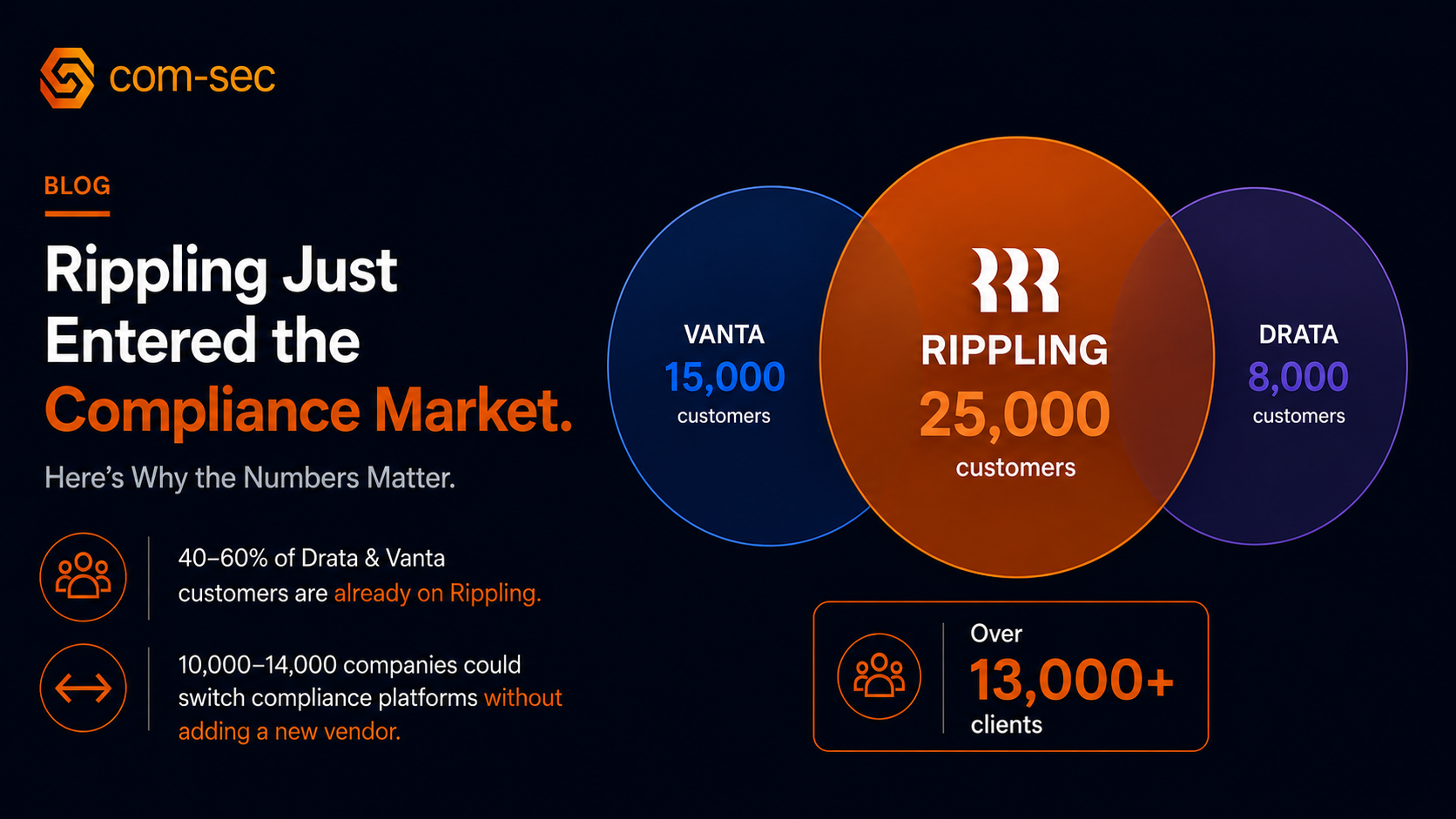
Rippling has over 25,000 customers. The majority are US-based, tech-forward companies with 20 to 500 employees. That's the exact same profile as the companies buying SOC 2 compliance platforms today.
Drata has about 8,000 customers. Vanta has about 15,000. Those are the two dominant players in compliance automation. Combined, roughly 23,000 customers.
Here's the thing: a large percentage of Drata and Vanta customers are probably already on Rippling for HR, IT, or device management. Rippling's sweet spot (tech startups, SaaS companies, growth-stage businesses) overlaps almost entirely with the companies pursuing SOC 2. Conservative estimates put that overlap at 40 to 60% of Drata and Vanta's combined customer base, roughly 9,000 to 14,000 companies that could switch their compliance tooling to Rippling without adding a new vendor.
Flip it the other way: of Rippling's 25,000 customers, an estimated 30 to 40% either already have a SOC 2 or will need one in the next 12 months. That's 7,500 to 10,000 companies that are either paying for a GRC platform today or about to start shopping for one.
We see this firsthand. Close to half of our almost 100 clients are on Rippling. That ratio is probably similar across most compliance firms serving startups and growth-stage companies.
That means Rippling isn't entering the compliance market from zero. They're entering it with a built-in customer base that's already paying them for the systems that generate most of the SOC 2 evidence.
The pricing picture
Getting through your first SOC 2 typically costs $25,000 to $60,000 all-in. That breaks down roughly:
GRC platform (Drata, Vanta, Secureframe): $10,000 to $25,000/year depending on company size and frameworks. Vanta starts around $10,000 for a single SOC 2 framework. Drata starts around $7,500. Both scale quickly with headcount and additional frameworks, and both have add-on costs that push real spend 30 to 50% above the base quote.
Audit (independent CPA firm): $15,000 to $35,000 for a Type II.
Pen test: $8,000 to $15,000.
Implementation/advisory support: $5,000 to $15,000.
Total year-one cost for most startups: $40,000 to $80,000 when you add it all up.
Rippling's compliance module starts at $12,000/year as an add-on to an existing platform subscription. If you're already paying Rippling $8 to $35 per employee per month for HR, payroll, IT, and device management, you're not adding a net-new GRC vendor to your budget. You're extending a platform you already have. At $12,000, it's priced right in line with Drata and Vanta's starting range, but the value proposition is different: the evidence is native, not pulled through integrations.
The audit and pen test costs don't go away. But the platform cost for compliance automation could drop significantly for companies already in the Rippling ecosystem.
Why this matters for the market
If even 20% of Rippling's 25,000 customers adopt the compliance module, that's 5,000 companies. That would make Rippling comparable to Drata in customer count overnight, and they haven't even launched ISO 27001, HIPAA, or GDPR support yet (all on the roadmap).
For Drata and Vanta, this is the first real structural competitor they've faced. Every other player in the market (Secureframe, Sprinto, Scytale, Thoropass) competes on the same model: a reporting layer that integrates with your tools. Rippling competes on a different axis entirely. They don't integrate with your HR, IT, and device management. They are your HR, IT, and device management. The evidence is native.
What Rippling's offering actually includes
A guided intake survey that scopes your audit and recommends controls. Pre-built controls mapped to Trust Services Criteria requirement codes with named owners. Continuous Evidence Monitors pulling live first-party data with row-level pass/fail visibility. A built-in risk register with inherent and residual scoring and treatment decisions captured automatically as evidence. When a control fails, the system tells you exactly which user, device, or vendor is the source and deep-links you to one-click remediation in the native Rippling product.
They coordinate independent CPA firms and pen testing partners for the actual audit. They push their partner firm, Johansen Group, but they let you bring your own auditor. That flexibility matters.
Currently supports SOC 2 Type I and Type II. ISO 27001, HIPAA, and GDPR are on the roadmap.
The open questions
How heavy is the migration for companies moving off Drata or Vanta? Control mappings, evidence history, audit trail continuity, and custom policies all need to transfer or be rebuilt. We have a client migrating next week and will have firsthand data soon.
What about controls that live outside Rippling's native scope? Application security, change management in your codebase, vendor risk management, and incident response still need coverage. The platform can't automate what it doesn't run.
And the biggest question: does the automated evidence hold up under real auditor scrutiny? The Delve scandal showed what happens when platforms produce evidence that looks like compliance but doesn't survive independent testing. Rippling's model of connecting with independent CPA firms rather than issuing reports in-house is the right structural answer. But the proof is in the audit.
The bottom line
Close to half of our almost 100 clients are already on Rippling. We're in the process of migrating our first client over to the compliance module now, so we'll see firsthand how the migration, evidence collection, and audit workflow actually hold up.
If this offering delivers on what we've seen in demos, it could meaningfully reduce the cost and complexity of SOC 2 for thousands of companies.
One note: Rippling has not been receptive to discussing partnerships on the vCISO, audit, or migration support side. That's their call. But if you're a company looking at this move and need help with the migration, the controls that live outside Rippling's scope, or the advisory work that no platform replaces, that's what we do. Reach out.
The compliance tooling market just got a lot more interesting.
Farbod Fakhrai is the founder of Com-Sec, a cybersecurity and compliance consulting firm supporting startups and growth-stage companies.