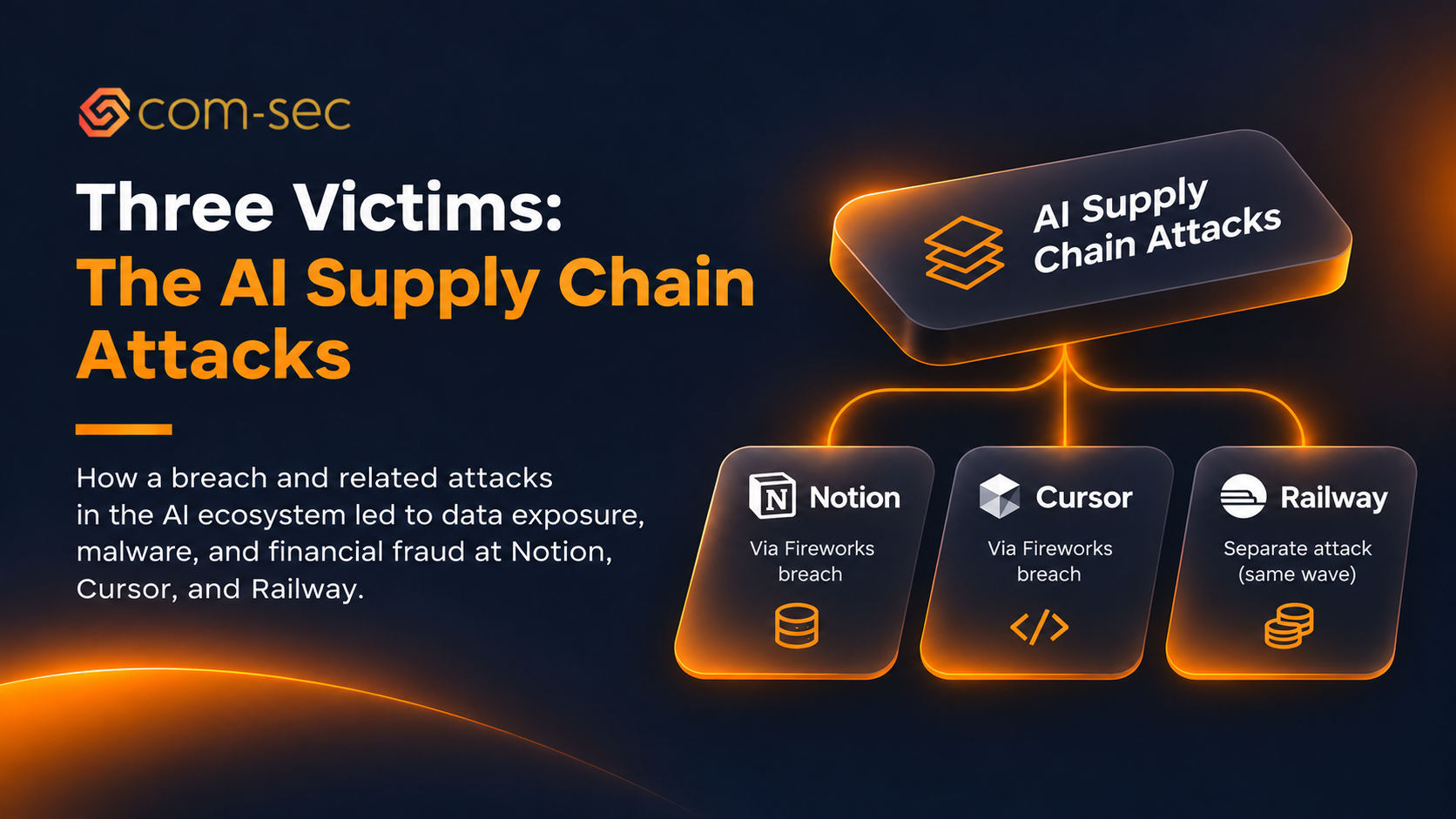
In fall 2026, Fireworks AI, an inference platform that runs AI models for other companies, disclosed two separate security incidents. Within weeks, two of its customers, Notion and Cursor, were hit downstream, and a third company, Railway, fell to a separate attack in the same wave. Each was hit in a completely different way.
This is what a modern supply chain attack looks like. And if your startup relies on AI tools, which most do now, this is exactly the kind of risk you need to understand.
WHAT HAPPENED AT FIREWORKS AI
Fireworks AI provides inference services, meaning other companies send data to Fireworks, and Fireworks runs AI models on that data and sends the results back. Their customers include some of the biggest names in productivity software and developer tools.
Fireworks has described two separate incidents.
On October 6, Fireworks identified unauthorized use of its internal credentials. In an incident that began in early August, an unauthorized party used them to access environment variables in evaluation jobs for a limited number of customer accounts. Fireworks believes API keys and tokens stored there were captured.
The second incident started on October 23, when a third-party cloud provider hosting Fireworks' development machines had its own security incident. An attacker used that access to reach Fireworks' development environment, exposing resource metadata, billing information and, for certain customers, incomplete model weights and datasets.
Two incidents. Two different entry points. One vendor whose customers paid the price.
VICTIM 1: NOTION
Notion uses Fireworks to run some of its AI features. After the breach, Notion discovered that AI chat transcripts from its "Insights" feature were sitting on Fireworks' servers despite a contractual commitment to zero data retention.
Less than 1% of Notion workspaces were affected, but the exposed data included conversations that Notion users had with Notion AI. For most affected workspaces, the chats were unattributable, meaning they weren't labeled with who wrote them or which workspace they came from. But that's cold comfort when your team's AI conversations are in someone else's breach disclosure.
Notion cut traffic to Fireworks within a day of being notified, deleted all data from the vendor's systems, and halted training runs. They gave affected workspace owners a way to review what was exposed.
VICTIM 2: CURSOR
Cursor, the AI-powered code editor, was hit differently. An access key that Cursor had issued to Fireworks was exposed in the breach. The attacker used it to reach Cursor's data, then used a separate credential found in that data to push a trojanized version of Anthropic's Claude Code extension into the cache that serves Cursor's marketplace. For about 11 hours, the tampered extension tried to install a persistent SSH backdoor on developers' machines.
This wasn't a data exposure. This was an active attack on developers through a trusted marketplace, made possible by a stolen credential from a vendor breach.
VICTIM 3: RAILWAY
Railway, a cloud platform used by developers, was hit in a separate attack during the same wave. Attackers exploited a vulnerability in Railway's own build infrastructure on October 20, but the goal was the same: AI provider credentials.
Attackers may have decrypted environment variables from up to 100,000 workspaces, and Railway estimates the stolen keys ran up about $740,000 in fraudulent AI usage charges. Customers found their keys being used to answer coding questions and run training tasks they never started. Railway is working with AI providers on refunds and covering the losses itself where they won't.
WHY THIS MATTERS FOR YOUR STARTUP
Three companies. Three completely different types of damage:
- Customer data exposure (Notion)
- Supply chain malware through a trusted marketplace (Cursor)
- Financial fraud through stolen credentials (Railway)
All connected to the same ecosystem of AI infrastructure providers.
This is the reality of building on AI tools in 2026. Your company doesn't just depend on the AI product you're using. You depend on the inference provider behind it, the cloud provider behind them, and every integration point in between.
WHAT YOU SHOULD DO
Map your AI supply chain. Most startups can name the AI products they use but can't name the companies that actually run the models. Ask your vendors: who provides your inference? Where does our data go? What happens to it after processing?
Don't rely on contracts alone. Fireworks had contractually committed to zero data retention for Notion's data. The data was there anyway. Contracts set expectations. Verification confirms reality. Ask for SOC 2 reports, architecture documentation, and evidence of data handling practices.
Rotate credentials regularly. Both the Cursor and Railway incidents involved stolen API keys and tokens. If your team stores AI provider credentials in environment variables, those credentials should be rotated on a schedule, not just when something goes wrong.
Audit your marketplace extensions. The Cursor incident shows that even trusted marketplaces can be compromised. Review what extensions and plugins your development team has installed. Verify publishers. Be skeptical of new or recently updated extensions from unfamiliar sources.
Have a vendor incident response plan. When one of your vendors gets breached, do you know what to do? Who reviews the disclosure? Who decides whether to cut traffic? Who notifies your customers if their data was involved? Write this down before you need it.
THE BIGGER PICTURE
The AI supply chain is young, fast-moving, and largely untested from a security perspective. Companies are integrating AI tools at a pace that security teams can't match. The result is a web of dependencies that most organizations don't fully understand until something breaks.
The Fireworks breach didn't just affect Fireworks. It cascaded through the companies that depended on them, and then to the customers of those companies. That's the nature of supply chain risk. Your vendor's problem becomes your problem, and your problem becomes your customer's problem.
If you're building on AI tools, the question isn't whether one of your vendors will have a security incident. It's whether you'll be ready when it happens.
Farbod Fakhrai is the founder of Com-Sec, a cybersecurity and compliance consulting firm for startups and growth-stage companies. com-sec.io