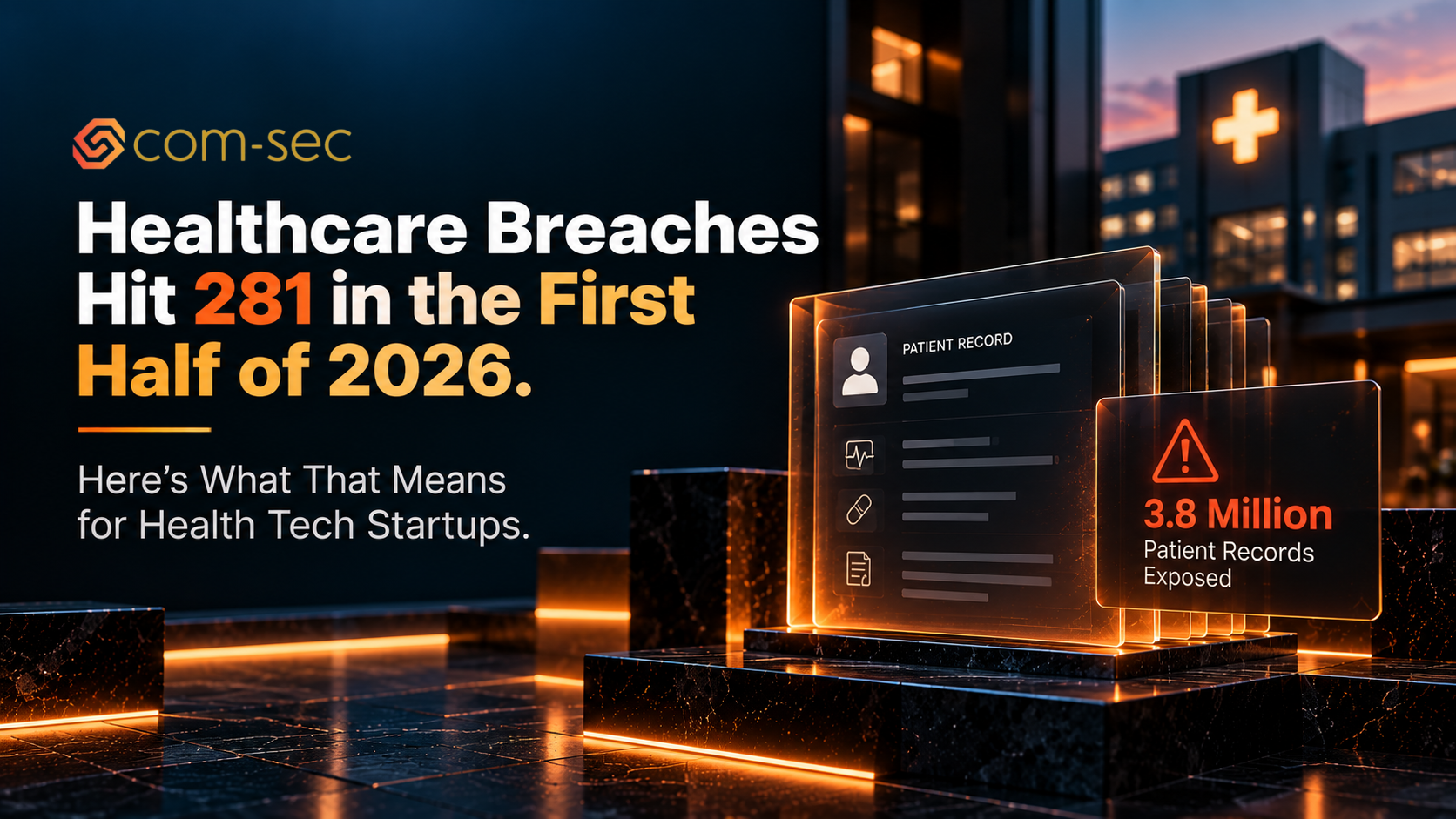
Healthcare data breaches aren't slowing down. They're accelerating.
According to recent reporting, there were 281 healthcare data breaches in the first half of 2026 alone. A single breach exposed 3.8 million patient records. The trend line from the last several years has been going in one direction, and it's not the one any of us want.
If you're building a health tech company, these numbers aren't just industry statistics. They're a preview of the threat landscape you're operating in.
Why healthcare is the target
Healthcare data is the most valuable data on the black market. A stolen credit card number is worth a few dollars. A stolen medical record — with a patient's name, date of birth, Social Security number, insurance information, and medical history — is worth significantly more. That data doesn't expire. You can't cancel your medical history the way you cancel a credit card.
On top of that, healthcare organizations are notoriously under-invested in security relative to the sensitivity of the data they handle. Hospitals, clinics, and health tech companies often run lean IT teams. Legacy systems are common. Budgets are tight. Security is seen as overhead, not a business function.
Attackers know all of this.
The startup exposure
Health tech startups face a particular version of this problem. You're handling sensitive patient data — ePHI under HIPAA — with a small team, limited security budget, and pressure to ship product quickly. The combination creates gaps.
Here's where I see health tech startups get exposed most often:
Insufficient access controls. Engineers have access to production databases with real patient data. Former employees still have active accounts. Service accounts with broad permissions are shared across teams. Every one of these is a breach vector.
Lack of encryption. Data is encrypted in transit but not at rest. Backups aren't encrypted. Staging environments contain real patient data without the same protections as production.
Weak vendor management. You're using third-party APIs, cloud services, and SaaS tools that touch patient data. But you haven't reviewed their security posture or confirmed they'll sign a BAA.
No incident response plan. If a breach happens today, what do you do? Who do you call? What do you tell your customers? What do you report to HHS? Most startups I work with don't have answers to these questions until we build them together.
Over-reliance on compliance. Having a HIPAA compliance program is necessary. It's not sufficient. Compliance tells you whether your controls are documented and designed. It doesn't tell you whether they're actually preventing breaches.
The business impact
A healthcare data breach isn't just a security event. It's a business event.
HIPAA penalties range from $100 to $50,000 per violation, with annual caps up to $2 million per violation category. The HHS Office for Civil Rights has been increasingly aggressive with enforcement.
But the regulatory fines are often the smallest cost. The real damage comes from:
- Customer loss. Health systems and enterprise buyers take breach history seriously. A breach can disqualify you from deals for years.
- Litigation. Class action lawsuits following healthcare breaches have become routine. Change Healthcare is facing billions in legal exposure.
- Reputation. In healthcare, trust is everything. Once it's lost, rebuilding it is slow and expensive.
- Operational disruption. Responding to a breach consumes your team for months. Product development stops. Sales cycles stall. Everything else takes a back seat.
What to do about it
This isn't a list of everything you should do. It's a list of the things that matter most for a health tech startup right now.
Conduct a real risk assessment. Not a checkbox exercise for your compliance program. An honest evaluation of where your most sensitive data lives, who can access it, and what controls protect it.
Implement MFA everywhere. Every system that touches ePHI. No exceptions. No "we'll get to it next quarter."
Minimize data access. Engineers don't need access to production patient data for development. Use synthetic or anonymized data in non-production environments. Restrict production access to the smallest number of people who genuinely need it.
Encrypt everything. At rest and in transit. Databases, backups, file stores, and any system that contains ePHI.
Get your BAAs in order. Every vendor, subcontractor, and service provider that touches ePHI needs a signed Business Associate Agreement. Review them annually.
Build and test your incident response plan. Know what you'll do before something happens. Run a tabletop exercise. Make sure your team knows the escalation path.
Invest in monitoring. You need to know when something suspicious is happening in your environment. Centralized logging with alerting on anomalous behavior is the minimum.
The bottom line
281 breaches in six months. That's more than one per day. The threat is real, it's growing, and health tech startups are not exempt.
The companies that invest in security now — not as a compliance checkbox but as a core business function — are the ones that will earn and keep the trust of health systems, patients, and partners. The ones that don't are gambling.
If you're building in health tech and want to make sure your security program can withstand scrutiny, let's talk.
Farbod Fakhrai is the founder of Com-Sec, a cybersecurity and compliance consulting firm for startups and growth-stage companies. com-sec.com