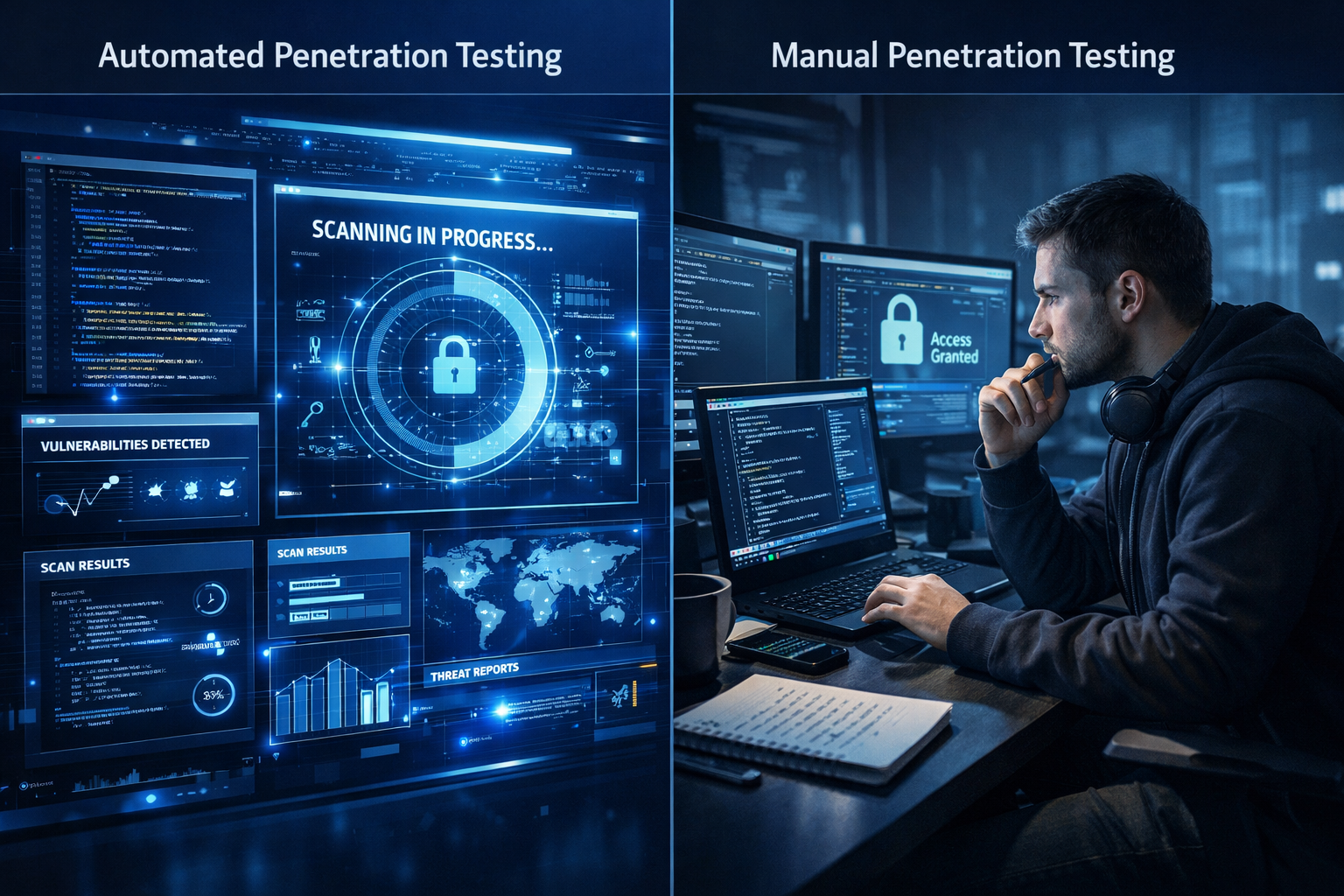
As cyber threats continue to evolve, businesses must proactively identify and remediate security weaknesses before attackers exploit them. Penetration testing remains a critical component of any cybersecurity strategy, helping organizations uncover vulnerabilities across applications, networks, and cloud environments.
In 2026, penetration testing typically falls into two primary approaches: automated penetration testing and manual penetration testing. Understanding the differences between these methods—and when to use each—is essential for building a resilient security posture.
What Is Automated Penetration Testing?
Automated penetration testing uses specialized tools and platforms to continuously scan systems, networks, cloud environments, and applications for known vulnerabilities and misconfigurations. Modern automated testing has evolved beyond basic scanners and now incorporates AI-driven detection, continuous monitoring, and DevSecOps integration.
Advantages of Automated Penetration Testing
Speed and Scalability: Automated tools can rapidly assess large and complex environments, making them ideal for organizations with cloud-native infrastructure, SaaS platforms, or frequent code changes.
Cost-Effective Security Coverage: Automated testing is more budget-friendly and well-suited for routine and continuous security assessments, helping businesses maintain visibility into their risk posture.
Known Vulnerability Detection: These tools excel at identifying known CVEs, misconfigurations, exposed services, and outdated software, allowing organizations to quickly remediate common issues.
Continuous Testing Support: In 2026, automated penetration testing is often integrated into CI/CD pipelines, enabling security testing earlier in the development lifecycle.
Limitations of Automated Penetration Testing
Limited Context Awareness: Automated tools cannot fully understand business logic, user workflows, or complex system interactions, which can lead to false positives or missed attack paths.
Inability to Simulate Real Attackers: While efficient, automation lacks the creativity and adaptability required to replicate sophisticated, multi-stage attacks.
What Is Manual Penetration Testing?
Manual penetration testing is performed by experienced security professionals who simulate real-world attacks using human judgment, creativity, and deep technical expertise. Manual testing focuses on how attackers actually think and behave, rather than simply identifying known vulnerabilities.
Advantages of Manual Penetration Testing
Deep Contextual Analysis: Manual testers analyze application logic, APIs, authentication flows, and system architecture to uncover vulnerabilities automated tools often miss.
Adaptive Attack Techniques: Human testers can pivot in real time, chaining vulnerabilities together to simulate realistic attack scenarios.
Zero-Day Discovery: Manual testing is essential for identifying zero-day vulnerabilities, privilege escalation paths, and complex exploitation techniques, especially in cloud and SaaS environments.
Compliance and Audit Readiness: Manual penetration testing is often required for SOC 2, ISO 27001, HIPAA, PCI DSS, and other compliance frameworks.
Limitations of Manual Penetration Testing
Time and Resource Intensive: Manual testing requires skilled professionals and more time, making it less suitable for continuous testing across all systems.
Higher Cost: Because of the expertise involved, manual penetration testing is typically reserved for critical systems, high-risk applications, and regulatory requirements.
Automated vs Manual Penetration Testing: Which Is Right for Your Business?
In 2026, the question is no longer automated or manual, but how to use both effectively.
Automated penetration testing is ideal for:
- Continuous security monitoring
- Cloud and SaaS environments
- Early detection of known vulnerabilities
- DevSecOps and CI/CD pipelines
Manual penetration testing is essential for:
- Business logic and API testing
- Complex attack simulations
- Zero-day discovery
- Compliance and audit requirements
The Best Approach in 2026: A Hybrid Penetration Testing Strategy
Modern organizations benefit most from a hybrid penetration testing approach that combines automation and human expertise. Automated penetration testing tools provide continuous visibility and efficiency, while manual testing delivers depth, context, and real-world attack simulation.
At Com-Sec, we leverage both automated and manual penetration testing methodologies to help businesses strengthen their security posture. Our experienced penetration testers work closely with your organization to design a testing strategy aligned with your infrastructure, risk profile, and compliance requirements.
Conclusion
In today's complex threat landscape, relying on a single penetration testing method is no longer sufficient. Automated penetration testing offers speed and scalability, while manual penetration testing provides depth and real-world insight. Together, they form a comprehensive defense strategy that businesses need in 2026.
Looking to secure your applications, cloud environment, or meet compliance requirements? Partner with Com-Sec for expert penetration testing services that combine automation, human expertise, and industry best practices.